
Hawaii Property Tax Records
Hawaii property tax records are public documents that show how each parcel of land is assessed, taxed, and classified across the state. Each of Hawaii's four taxing counties runs its own real property assessment division, so the records you need may sit with the Honolulu RPAD, the Hawaii County Real Property Tax Division, the Maui County assessment office, or the Kauai County Finance Department. This guide explains how to search Hawaii property tax records online, what those records contain, and how to use county portals to look up any parcel by owner name, address, or Tax Map Key number.
Hawaii Property Tax Overview
How Hawaii Property Tax Works
Hawaii is one of the few states that delegates all real property tax administration to its counties. Before 1980, the state played a larger role, but extensive amendments to Hawaii Revised Statutes Chapter 246 shifted full authority to the counties. Each county now sets its own tax rates, determines classification rules, runs its own assessment division, and collects its own property taxes. The state still sets the legal framework under HRS Chapter 246, including the requirement that all real property be assessed at 100 percent of fair market value, but day-to-day administration is entirely local.
There are four counties that levy property taxes in Hawaii: Honolulu County (Oahu), Hawaii County (the Big Island), Maui County (Maui, Lanai, and Molokai), and Kauai County. A fifth county, Kalawao, exists on the Molokai coastline but has no county government and levies no property tax of its own. The tax year runs from July 1 through June 30 for all counties. Property owners pay in two installments each year, with the first half due August 20 and the second half due February 20. Combined, the four taxing counties collect roughly $2.2 billion in property taxes annually, making real property the primary source of local government revenue across the state.
Tax rates vary widely between counties and between property classes within each county. Honolulu County accounts for about 65 percent of the total assessed value statewide. Maui County holds around 15 percent, Hawaii County about 12 percent, and Kauai County the remaining 8 percent. Each county classifies property by actual use, not just zoning, which means how you use your land determines your tax rate. Common classifications include Residential, Residential A (investment), Commercial, Industrial, Agricultural, and Hotel/Resort.
The Hawaii State Data Book at dbedt.hawaii.gov tracks property tax statistics across all counties. Section 9.40 through 9.50 covers valuations, rates, exemptions, and collections in detail, with historical data going back decades.
The State of Hawaii Data Book, published by the Department of Business, Economic Development and Tourism, documents that over 300,000 exemptions are granted annually across all counties.
The State of Hawaii Data Book at dbedt.hawaii.gov publishes annual property tax statistics for all four taxing counties, including assessed valuations and collections data by land use class.
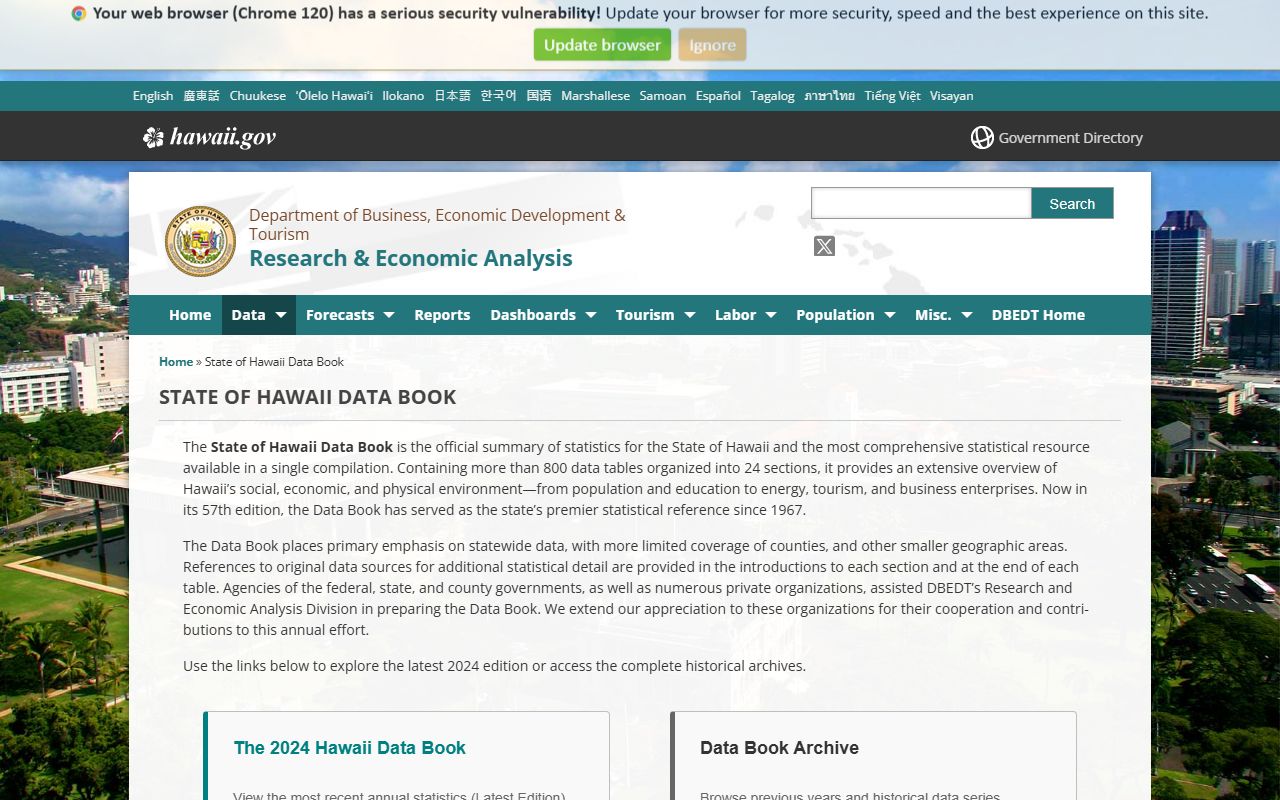
The data shows consistent annual increases in assessed values of 3 to 5 percent across most counties, with Honolulu representing nearly two-thirds of total statewide assessed value.
Search Hawaii Property Tax Records Online
Each county provides an online portal for property tax record searches. Honolulu County uses the Real Property Assessment Division portal at realproperty.honolulu.gov, which supports searches by Tax Map Key, owner name, or street address. Hawaii County, Maui County, and Kauai County all use the qPublic platform, a standardized interface that displays assessed values, building characteristics, ownership history, and sales records. These systems are free to use and available around the clock.
When you search for a property record, results typically show the parcel's current assessed value for land and improvements, total assessed value, applicable exemptions, net taxable value, property classification, and the current tax amount. Most systems also include a sales history tab showing prior deed transfers with recording dates and declared values. For condominiums, look for the complete Tax Map Key including the unit number component, since each condo unit has its own record. The Honolulu database shows ownership records, building characteristics, and prior year tax amounts. It also lets you print property record summaries and export data.
For the most current Maui County property tax records, the qPublic portal at qpublic.net/hi/maui covers all three islands in Maui County. The Kauai system at qpublic.net/hi/kauai includes a GIS map layer showing parcel boundaries. Hawaii County's system at qpublic.net/hi/hawaii also provides a Comparable Sales tool to view recent sales near any subject property.
The Hawaii State Legislature's website posts the full text of HRS Chapter 246, the foundational statute for real property taxation, organized by section with links to prior versions and amendments.
Chapter 246 has been the legal foundation for Hawaii property tax since 1980, when the legislature decentralized administration from the state to the individual counties while keeping statewide assessment standards in place.
Hawaii Tax Map Key (TMK) System
Every parcel in Hawaii has a unique Tax Map Key, or TMK, that works as the property's identifier across all government records and databases. The full TMK format uses five components separated by hyphens: Island-Zone-Section-Plat-Parcel. The first digit tells you the island: 1 is the Big Island of Hawaii, 2 is Maui, 3 is Kalawao, 4 is Oahu, and 5 is Kauai. The zone, section, plat, and parcel digits narrow it down to the specific tax map. For condominiums and CPR units (Condominium Property Regimes), a sixth component is added to identify the individual unit.
When searching different county databases, you often need to adjust the TMK format. Some systems require all ten digits with hyphens. Others want nine digits without the island code and without hyphens. The Bureau of Conveyances uses the full TMK with hyphens. Honolulu's RPAD and the qPublic systems for other counties often use just the nine-digit version. Knowing which format each system expects will save you time when doing research. The TMK was first developed in the 1930s for tax assessment but is now the standard parcel identifier for planning, permits, and emergency services throughout the state.
Note: When entering a TMK in any county search portal, always check the format instructions shown on the search page before you type.
Hawaii Bureau of Conveyances
The Hawaii Bureau of Conveyances, operated by the Department of Commerce and Consumer Affairs, maintains the statewide recording system for all property-related documents. Hawaii is one of only two states in the country with a fully unified statewide recording system. The Bureau processes over 344,000 documents each year through its RecordEASE portal. Documents include deeds, mortgages, easements, powers of attorney, liens, and UCC filings. Both the Regular System and the Land Court System (Torrens system) are available through a single search interface.
The Regular System covers about 60 percent of Hawaii properties while the Land Court System covers the remaining 40 percent. Under HRS Chapter 502, all instruments affecting real property must be recorded to provide public notice. Section 502-31 of that chapter makes unrecorded interests void against subsequent bona fide purchasers. The Land Court system goes further by issuing certificates of title that serve as conclusive evidence of ownership. You can search by grantor or grantee name, document number, document type, date range, or TMK. Document images are viewable from the public portal, though certified copies must be ordered separately.
Recording fees are set under HRS Chapter 502. The base fee is $38 for the first five pages of any document, with each additional page at $1. Conveyance tax applies to all property transfers at rates from 10 cents per $100 for owner-occupied residential properties up to $1.00 per $100 for investment properties. Certified copies cost $10 for the first page plus $1 for each additional page. Plain copies are $1 per page.
The Hawaii Bureau of Conveyances fee schedule at cca.hawaii.gov lists all recording fees, copy costs, and conveyance tax rates for property documents filed statewide.
The fee schedule is updated when the legislature or the Department of Commerce and Consumer Affairs adjusts the rates, so it is worth checking the current schedule before submitting any document for recording.
Property Tax Exemptions in Hawaii
Hawaii property tax exemptions reduce the taxable assessed value of your property, which lowers your tax bill. Every county offers a homeowner exemption for owner-occupied primary residences, though the amounts and eligibility rules differ significantly. Honolulu County provides a $120,000 exemption for owners under 65 and $160,000 for owners 65 and older, with those amounts set to rise to $140,000 and $180,000 effective July 1, 2027. Maui County offers a flat $200,000 exemption, the largest in the state, though it requires the owner to have filed Hawaii income taxes from a Maui address for at least two consecutive years. Hawaii County uses an age-based scale starting at $50,000 for owners under 60 and rising to $125,000 for owners 80 and older, plus an additional 20 percent exemption for long-term homeowners with incomes under $100,000. Kauai County provides $160,000 for owners under 60 and $200,000 for those 60 and older.
To keep an exemption, you must occupy the property as your primary residence. You can only hold one homeowner exemption statewide. Properties held in the name of an LLC, corporation, or partnership do not qualify. If you rent out a portion of your home, that may reduce or remove the exemption. All counties require owners to report changes in status within 30 days. Failing to report changes leads to rollback taxes and penalties.
Beyond homeowner exemptions, all counties offer programs for disabled veterans, persons with disabilities, and qualified agricultural properties. Maui County also has a Long-Term Rental Exemption under Bill 129 that gives a $200,000 reduction for properties rented to the same tenant for 12 consecutive months or more.
Deadlines to apply vary by county. Honolulu requires filing by September 30. Hawaii County has June 30 and December 31 deadlines. Maui and Kauai use December 31. Late applications are generally not accepted. Forms are available on each county's website or in person at their assessment offices.
Assessment and Appeals for Hawaii Property Tax Records
All four taxing counties assess property at 100 percent of fair market value, as required by HRS Chapter 246. Each county uses mass appraisal techniques, including Computer Assisted Mass Appraisal systems, to value hundreds of thousands of parcels each year. Field appraisers conduct exterior inspections on a rotating basis, typically every six to eight years. Interior inspections happen only with owner consent or for appeal purposes. New construction is added to the roll when certificates of occupancy are issued.
If you think your assessed value is wrong, you can appeal. Each county has its own Board of Review and its own deadline. Honolulu's appeal period runs December 15 through January 15. Hawaii County requires appeals by April 9. Maui County also sets April 9 as the deadline. Kauai County's deadline falls on December 31. Most counties charge a $50 filing fee per parcel, refunded if the appeal succeeds. Appeals must state the grounds, include your opinion of value, and provide supporting evidence such as comparable sales or an appraisal.
Under HRS Section 246-15, property owners who are unhappy with a Board of Review decision may appeal to the Hawaii Tax Appeal Court within 30 days of the decision. The Tax Appeal Court handles valuation disputes statewide and operates under specialized rules to move cases along faster than general civil litigation. Further appeals go to the Hawaii Intermediate Court of Appeals and then the Hawaii Supreme Court.
The Hawaii State Judiciary website at courts.state.hi.us provides information on the Tax Appeal Court, which has exclusive jurisdiction over property tax assessment disputes appealed from the county boards of review.

Taxpayers who disagree with a Board of Review decision have 30 days to file with the Tax Appeal Court, and cases are heard before judges with expertise in property valuation and tax law.
Your Right to Access Hawaii Property Tax Records
Property tax records in Hawaii are public records under the Uniform Information Practices Act, codified in Chapter 92F of the Hawaii Revised Statutes. Section 92F-12 establishes a presumption of public access to government records. Assessment records, ownership information, and tax payment history are all available to anyone who asks. You do not need to be the property owner to request these records. You do not need to give a reason. The agencies that hold these records must respond to requests within 10 business days.
Some information in property tax files may be protected. Social Security numbers are redacted from public records. Certain personal financial information in exemption applications may be withheld. Home addresses for individuals in protected categories may also be restricted. But the core assessment data, ownership history, and tax records are open. If an agency denies your request, you may appeal to the Office of Information Practices.
Fees for copying records are limited to actual reproduction costs, typically 10 cents per page for paper copies. Electronic records can be requested in searchable formats when they are available in that form. For certified copies of recorded documents from the Bureau of Conveyances, the fee is $10 for the first page plus $1 for each additional page.
The full text of HRS Chapter 502 governing the Bureau of Conveyances and the recording of land documents in Hawaii is published on the Hawaii State Legislature's website.
Section 502-31 of this chapter is one of the key provisions in Hawaii property law, establishing that unrecorded interests are void against later purchasers who pay fair value without notice of the prior interest.
Browse Hawaii Property Tax Records by County
Each Hawaii county maintains its own property tax records and runs its own assessment office. Select a county below to find the local search tools, office contact details, exemption programs, and appeal procedures for that area.
Property Tax Records in Major Hawaii Cities
Hawaii does not have independent city-level property tax systems. All property tax is administered at the county level. The pages below explain how property tax records work for residents of Hawaii's largest communities.