
Maui County Property Tax Records
Maui County property tax records cover roughly 72,000 parcels spread across three islands: Maui, Lanai, and Molokai. The Real Property Assessment Division, based in Wailuku, handles all assessments, exemptions, and billing for the county. You can search parcel data and assessment history online through the county's public portal, or visit one of three island offices in person. This page explains how the system works, where to find records, and what programs may lower your tax bill.
Maui County Overview
Real Property Assessment Division
The Maui County Real Property Assessment Division runs offices on all three islands it serves. The main office sits at 200 S. High Street in Wailuku. That location has public research computers with print access, so you can look up parcel data without going home to do it. For people on Lanai or Molokai, there are branch offices to handle questions and transactions closer to home. All three offices share the same phone number and keep the same hours.
Staff at any of the three offices can help with assessments, exemption forms, and questions about your bill. For complex appeals or detailed appraisal questions, the county recommends scheduling an appointment ahead of time rather than walking in. You can also reach the office by email at realproperty@mauicounty.gov. The main county portal at mauipropertytax.com has forms, rate tables, and appeal information available around the clock.
Lanai and Molokai residents have full access to all the same programs and services as those on the main island. The three-island structure is a practical reality of Maui County's geography. Governing more than one island adds some complexity, but the assessment rules apply equally across all parcels under HRS Chapter 246.
| Office (Main) | Real Property Assessment Division - Wailuku |
|---|---|
| Address |
200 S. High Street Wailuku, HI 96793 |
| Lanai Office | 301 6th Street, Lanai City, HI 96763 |
| Molokai Office | 55 Makaena Place, Kaunakakai, HI 96748 |
| Phone | (808) 270-7691 |
| Hours | Monday through Friday, 8:00 AM to 4:00 PM |
| realproperty@mauicounty.gov | |
| Website | mauipropertytax.com |
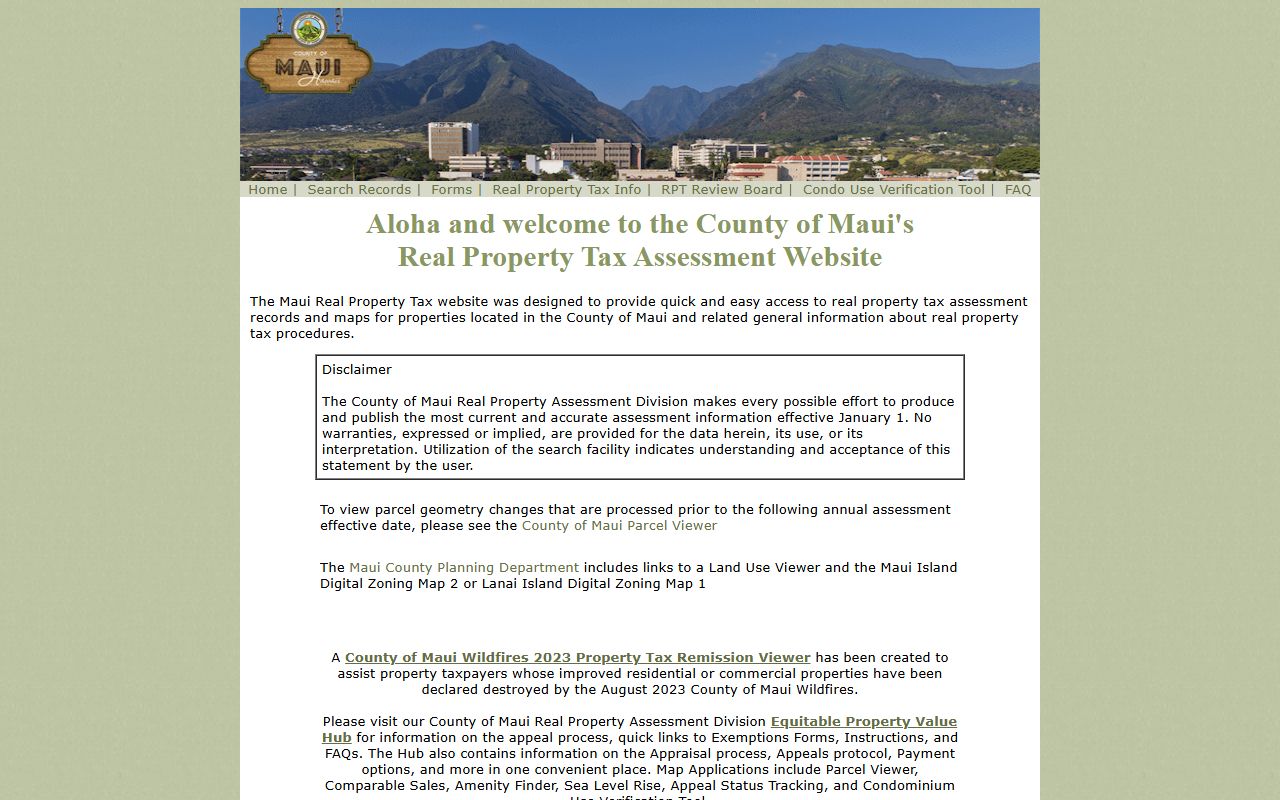
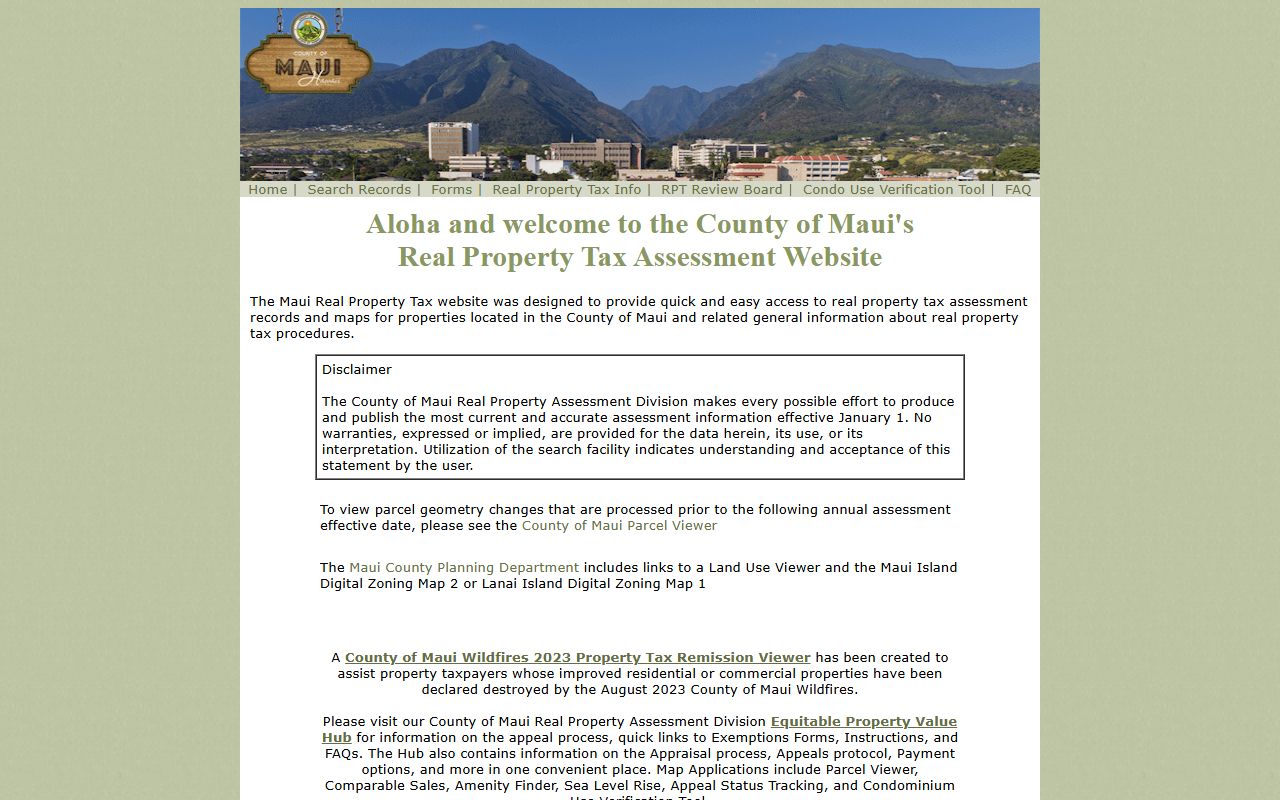
The county's main website screenshot below shows the portal layout and quick-access tools available to property owners and researchers.
The Maui County Real Property Tax Division website serves as the central hub for assessments, exemptions, appeals, and billing information across all three islands.
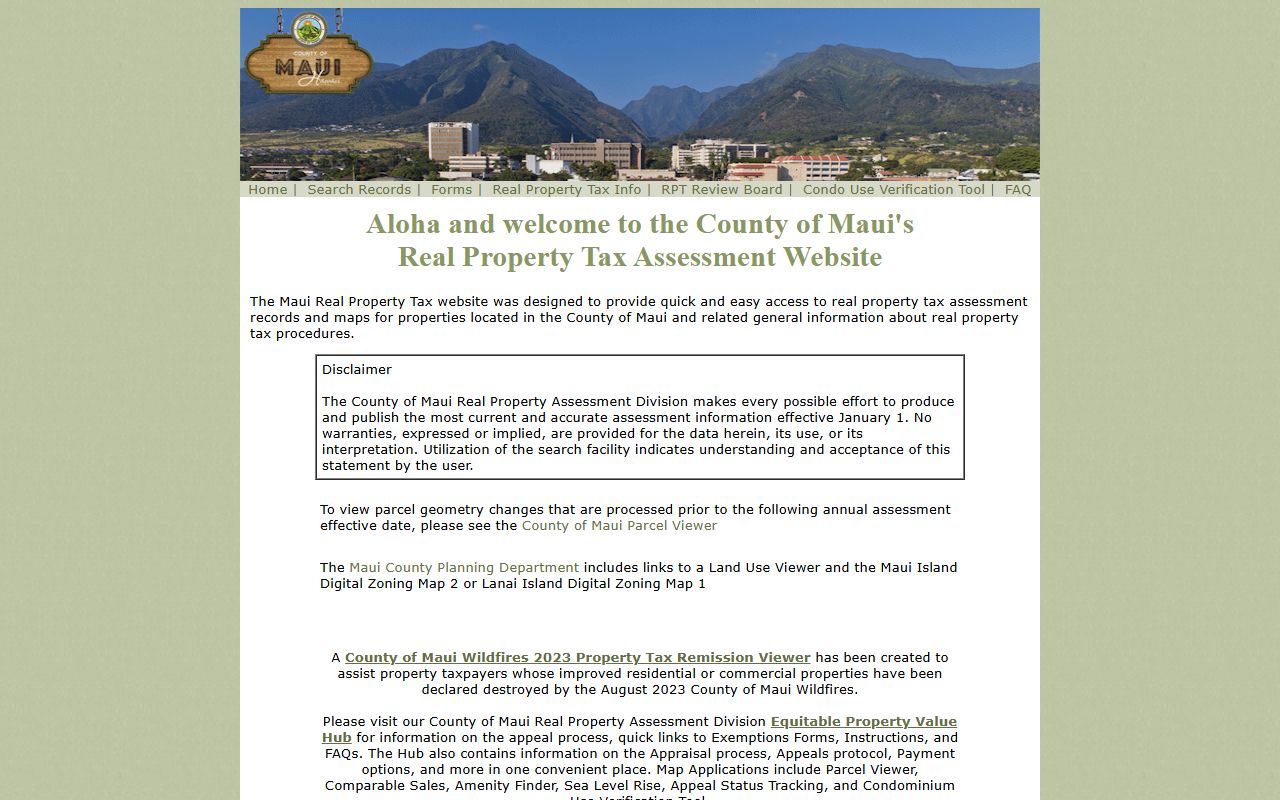
The portal organizes key tasks into clear categories, making it easier to find parcel data, download forms, or start an appeal without calling the office.
Search Maui County Property Tax Records
Maui County uses the qPublic platform for online parcel searches. The system covers all three islands and lets you search by TMK number, street address, owner name, or parcel ID. TMK stands for Tax Map Key, the nine-digit code that identifies each parcel in the Hawaii system. If you know your TMK, it is the fastest way to pull up the right record.
The qPublic portal at qpublic.net/hi/maui does more than show current assessed values. It includes a Comparable Sales feature that lets you filter recent sales by date, distance from your parcel, and property characteristics. That tool is useful if you are thinking about filing an appeal and want to build your own comparison before going to the Board of Review. You can also use the condominium verification tool to check unit classification and exemption status, which matters a lot in resort areas where condo use varies widely between owner-occupied, long-term rental, and vacation rental categories.
During the annual appeal period, the portal connects directly to the appeals filing system. You can start your formal appeal online without mailing a paper form. The system also links to the county's GIS layers so you can view zoning, flood zones, and planning overlays on top of your parcel data. That kind of layered view helps owners who are appealing based on comparable properties or challenging a use classification.
The screenshot below shows the qPublic search interface for Maui County, including the field options and parcel detail layout.
Parcel searches on qPublic for Maui County cover all islands and include assessed values, ownership history, and comparable sales data.
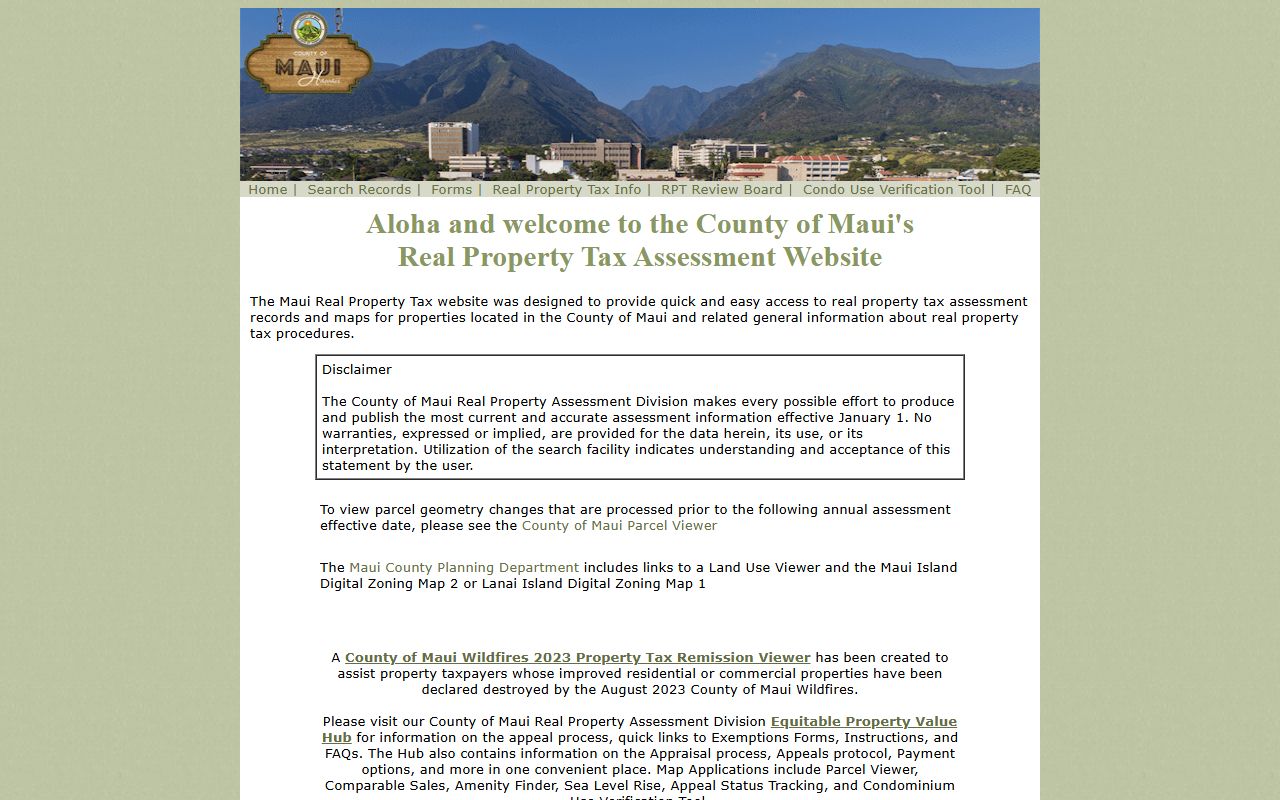
Search results show parcel details, assessment history, tax amounts, and any exemptions currently applied to the property.
Maui County Tax Rates and Classifications
Maui County uses a tiered rate structure that varies by property class and, for owner-occupied homes, by assessed value. The tiered owner-occupied rates were introduced to ease the burden on moderate-value homeowners while applying higher rates to high-value properties. Under HRS Chapter 246, counties in Hawaii set their own tax rates within the state framework, which is why rates differ across the four counties.
For owner-occupied homes, the rate depends on total assessed value. Homes at $1 million or less pay $1.80 per $1,000 of value. That rate goes to $2.00 per $1,000 for the portion of value between $1 million and $3 million. Homes valued above $3 million pay $3.25 per $1,000 on the amount over that threshold. Non-owner-occupied residential properties pay $6.31 per $1,000. Short-term rentals, meaning properties rented for less than 180 days at a time, carry the highest residential rate at $11.75 per $1,000. That rate reflects the county's policy push to discourage vacation rentals in favor of long-term housing supply.
Other rates by class:
- Commercialized Residential: $8.25 per $1,000
- Apartment: $4.50 per $1,000
- Commercial: $7.00 per $1,000
- Industrial: $7.00 per $1,000
- Agricultural: $5.89 per $1,000
- Conservation: $6.25 per $1,000
Classification is based on actual use as of the January 1 assessment date. If a property changes use during the year, that change does not take effect for tax purposes until the next assessment cycle. Owners who believe their property is in the wrong class can challenge the classification as part of the appeal process. Big changes to Maui's classification rules came in 2022, when the long-term rental category was added and vacation rental classifications were adjusted to reflect the county's housing goals.
The county posts the full rate table online. The screenshot below shows the rates and classification descriptions as they appear on the county's website.
The Maui County tax rates page shows current rates by class and explains the tiered owner-occupied structure in plain terms.
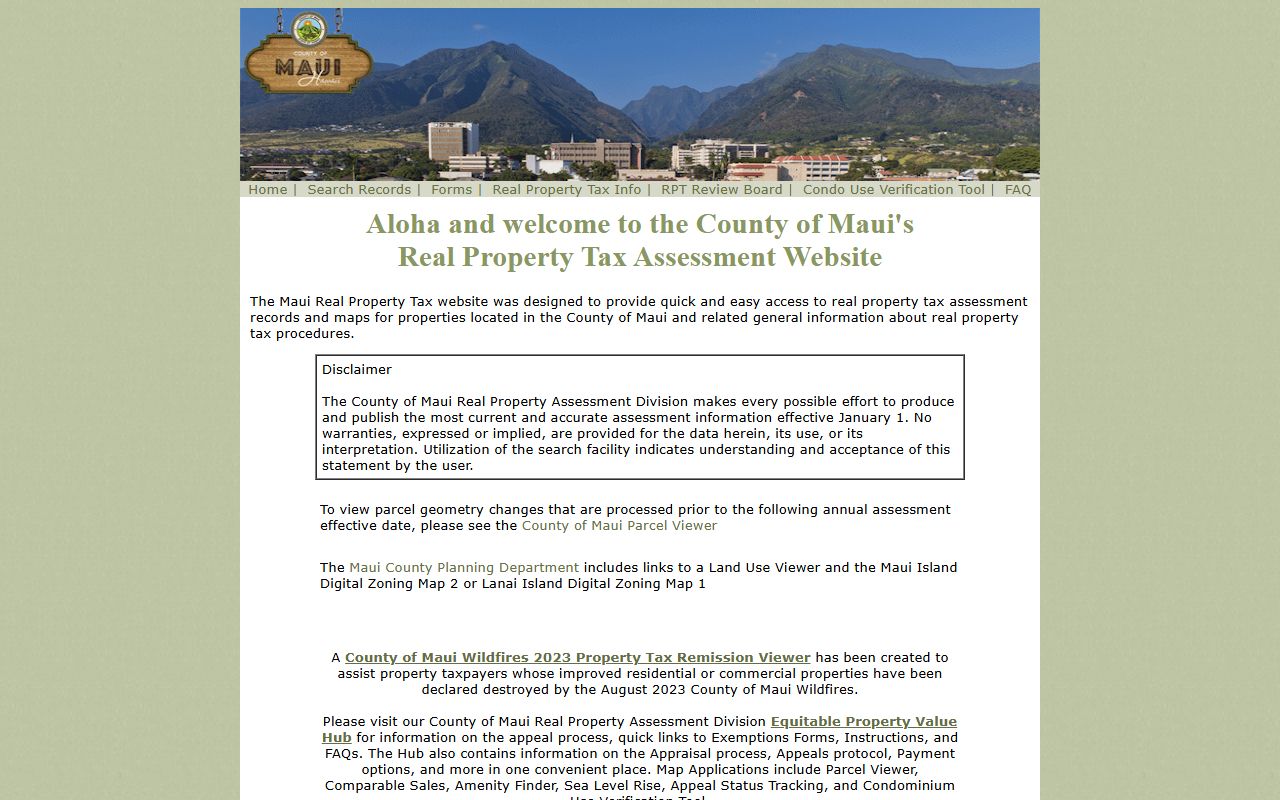
Rates are set annually by the Maui County Council and take effect at the start of the fiscal year on July 1.
Home Exemption in Maui County
Maui County offers a flat $200,000 homeowner exemption, which is the largest of any county in Hawaii. The exemption reduces the assessed value used to calculate your tax bill, so it can mean a significant savings for owner-occupants in lower and mid-value brackets. To get it, you must be the owner of record and use the property as your primary home as of January 1.
There is a unique requirement in Maui County that sets it apart from the other counties. You must have filed Hawaii state income taxes using a Maui County address for at least two consecutive years before the exemption takes effect. That rule catches people who have recently moved to Maui from another county or from the mainland. If you just bought a home and moved in, you may need to wait one or two years before the full exemption kicks in. People who have lived in Maui County for years and already have the exemption on file do not have to worry about this rule going forward, but new owners should plan for it.
Properties held in a trust can still qualify. The trustee and the beneficiary both need to meet the occupancy conditions. LLCs, corporations, and partnerships do not qualify, no matter how the property is used. The exemption also follows a one-per-individual rule statewide, which means you cannot claim a homeowner exemption in Maui County if you already have one in Honolulu County or elsewhere in Hawaii. That includes your spouse's exemptions.
The deadline to file for the exemption is December 31 of the year before you want it to apply. The form is available online and at any of the three division offices.
The exemption application form is shown below. You can download it from the county website and submit it by December 31.
The Maui County homeowner exemption application is a short form that asks for ownership proof, occupancy declaration, and your Hawaii tax filing history.
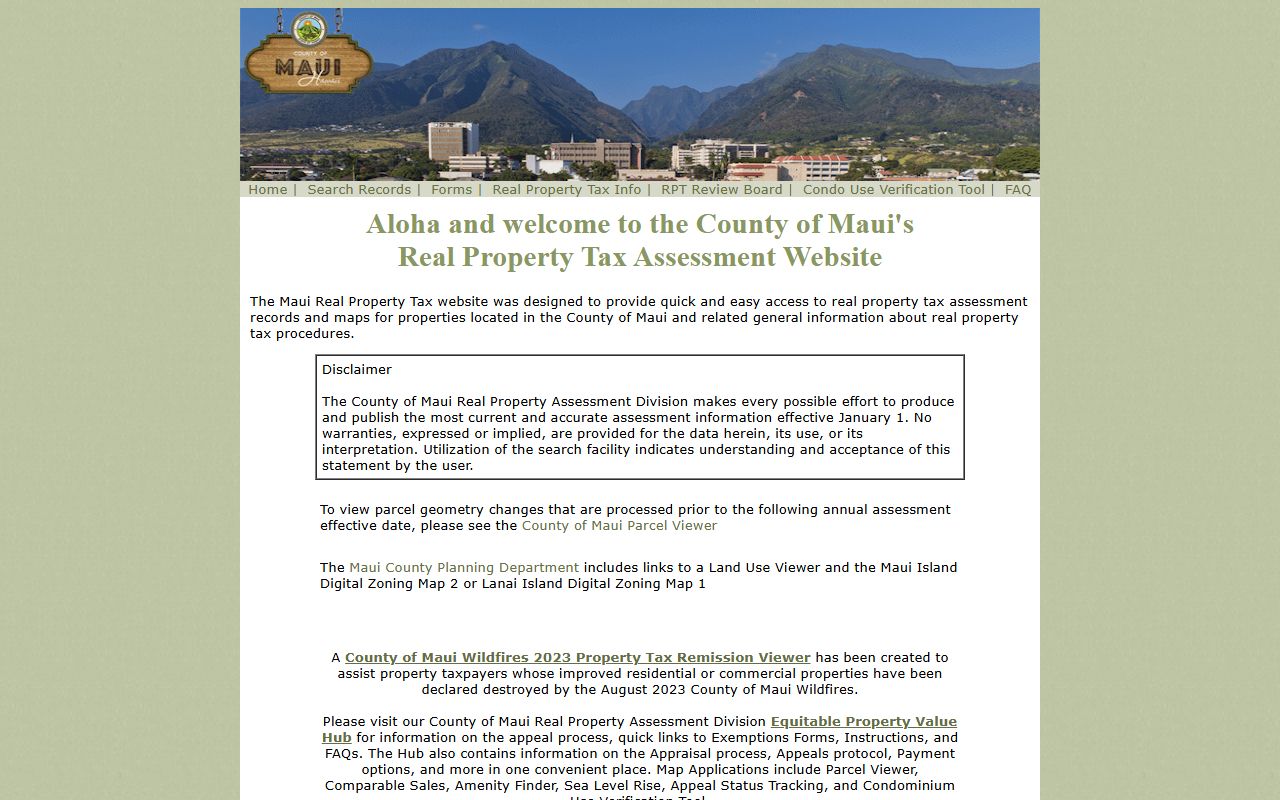
Submit the completed form to any Real Property Assessment Division office or by email before the December 31 deadline.
Long-Term Rental Exemption
Maui County created a long-term rental exemption under Bill 129 to increase the supply of housing available for local residents. The program gives property owners a tax break for renting to the same tenant for at least 12 consecutive months under a written lease. It is designed to make long-term renting more financially competitive with vacation rentals, which carry a much higher tax rate.
The exemption amount depends on whether the homeowner exemption already applies to the property. If the property does not have the homeowner exemption, the long-term rental exemption is $200,000. If the homeowner exemption is already in place, such as for an ohana unit or second dwelling on the same parcel, the rental exemption adds another $100,000 on top, for a total of $300,000 in combined exemptions. That combination can make a real difference for multi-unit properties where one unit is owner-occupied and another is rented long-term.
To qualify, the lease must be for residential use and cover a term of at least 12 months. Month-to-month arrangements can count if the same tenant has lived there for 12 or more consecutive months. The owner, not just a property manager or agent, must be a party to the lease. The exemption requires annual renewal with updated lease documentation. Properties that have any active short-term or vacation rental use do not qualify. That restriction is firm. If a unit is used even part of the year for vacation rentals, the long-term rental exemption is off the table.
The screenshot below shows the long-term rental exemption form available through the county's website.
Download the Maui County long-term rental exemption form to apply or renew annually with current lease documentation.
Annual renewal is required. Submit updated lease documentation each year to keep the exemption active.
Assessment and Appeals Process
All 72,000 parcels in Maui County are assessed at 100% of fair market value as of January 1. The county uses a Computer Assisted Mass Appraisal (CAMA) system for the bulk of assessments. That system analyzes sales data, property characteristics, and market trends to set values across large groups of similar parcels. Individual appraisals happen for complex or unique properties where mass appraisal models are less reliable.
Assessment notices go out around March 20 each year. Owners who disagree with their assessed value or classification have until April 9 to file an appeal, which is roughly 30 days from when the notices are mailed. If the county issues an amended assessment notice after April 9, a new 30-day appeal window opens from the date of that amended notice. The filing fee to appeal is $50 per parcel. You can file online through the qPublic portal during the open appeal period, or you can submit a paper form to the division office.
Appeals go first to the Board of Review, which holds hearings and reviews evidence from both sides. If you are still not satisfied after the Board of Review decision, you can take the case to Tax Appeal Court within 30 days. The court process follows Hawaii's rules for tax appeals under HRS Chapter 246. Most owners who pursue appeals at the Board of Review level resolve their cases there without going to court.
Tax bills follow a two-payment schedule. The first half is billed around July 20 and due by August 20. The second half is billed around January 20 and due by February 20. Property transfers and conveyances are recorded through the state's Bureau of Conveyances under HRS Chapter 502, which feeds ownership data back to the county's assessment records.
One notable recent event: after the August 2023 Lahaina and Kula wildfires, the county set up a property tax remission program for affected parcels. Owners with fire-damaged properties in those areas were able to apply for reduced assessments reflecting the actual condition of their property after the disaster.
Key dates at a glance:
- January 1: Assessment date
- March 20: Assessment notices mailed
- April 9: Appeal deadline
- December 31: Exemption filing deadline
- August 20: First-half tax payment due
- February 20: Second-half tax payment due
The screenshot below shows the contact and office information page, which also lists current mailing addresses and hours for each island office.
The Maui County Real Property Assessment Division contact page has office addresses for Wailuku, Lanai City, and Kaunakakai along with phone and email details.
Walk-ins are welcome during business hours, but appointments are recommended for appeals, exemption questions, or detailed parcel reviews.
Cities in Maui County
Property owners in all Maui County communities deal with the Real Property Assessment Division for assessments, exemptions, and appeals. The links below go to pages with more specific information for each major city.
Other communities in Maui County include Lahaina, Kula, Makawao, Paia, Haiku, Lanai City, and Kaunakakai. All parcels in these areas go through the same county assessment system.
Other Hawaii Counties
Hawaii has four counties. If you own property on a different island, your records and assessment office will be in a different county system.