
Access Kihei Property Tax Records
Kihei property tax records are maintained by the Maui County Real Property Assessment Division, which handles all assessments, tax classifications, exemptions, and billing for this popular South Maui coastal community. Property values in Kihei vary widely depending on location, use, and whether a unit qualifies as a vacation rental. Beachfront condominiums can reach into the millions, while inland residential properties sit in more moderate ranges. The county taxes short-term rentals at the highest residential rate in Maui County, making accurate classification and permitting critical for owners who rent their properties. All records are searchable online through Maui County's free public portals.
Kihei Overview
Where to Find Kihei Property Tax Records
All Kihei property tax records are held by the Maui County Real Property Assessment Division. There is no Kihei-specific satellite office. The main county office handles assessments, exemptions, appeals, and billing for all of Maui County's islands and communities, including Kihei. For most Kihei owners, the online portals handle common needs without requiring an office visit.
The Maui County RPAD main office is at 200 S. High Street, Wailuku, HI 96793. Phone is (808) 270-7691. Email is realproperty@mauicounty.gov. Hours run Monday through Friday, 8:00 AM to 4:00 PM. Wailuku is on the opposite side of Maui from Kihei, so phone and online contact are often more practical for South Maui owners. Staff are reachable by email for questions that do not require an in-person visit.
| Office | Maui County Real Property Assessment Division |
|---|---|
| Address | 200 S. High Street Wailuku, HI 96793 |
| Phone | (808) 270-7691 |
| realproperty@mauicounty.gov | |
| Hours | Monday through Friday, 8:00 AM to 4:00 PM |
| Portal | mauipropertytax.com |
| Property Search | qpublic.net/hi/maui/ |
The Maui County property tax portal at mauipropertytax.com is the hub for all RPAD services. Exemption forms, tax rate schedules, appeal information, and key dates are all there. The public parcel search at qpublic.net/hi/maui/ covers all Maui County islands and lets anyone look up a Kihei parcel by owner name, address, or tax map key number at no cost.
The image below shows the Kihei Public Library, which provides access to property records research materials and Maui County assessment resources for local owners and researchers.
Kihei Public Library - Hawaii State Public Library System
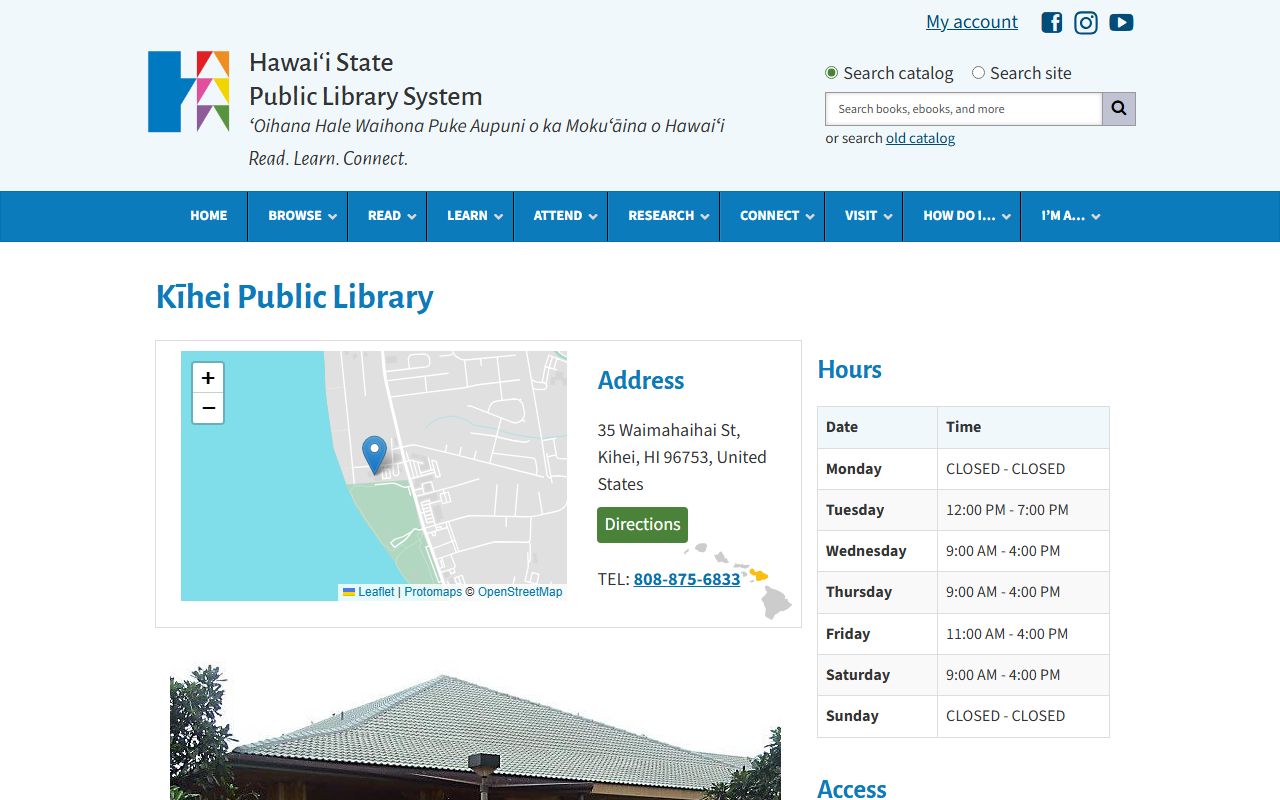
The Kihei Public Library provides a local research option for owners who want to review Maui County assessment histories, property documents, and related records without traveling to Wailuku.
Vacation Rental Tax Rates in Kihei: What Owners Must Know
Kihei has more short-term rental activity than almost anywhere else in Maui County. That concentration means Maui County pays close attention to rental classification in Kihei. Tax rates vary dramatically depending on how your property is classified, and the difference between classifications is not small. The wrong classification can cost thousands of dollars per year in either direction.
Short-term rentals used under 180 days are taxed at $11.75 per $1,000 of assessed value. That is the highest residential rate in Maui County. Non-owner occupied residential properties that are not short-term rentals face $6.31 per $1,000. Owner-occupied homes valued under $1 million pay just $1.80 per $1,000. The full rate schedule is at mauipropertytax.com. Your actual tax rate depends entirely on which class RPAD assigns your parcel.
Maui County actively monitors online rental listings and conducts site inspections to catch properties operating as short-term rentals without proper permits. Properties cited for illegal vacation rental use face fines, reclassification, and potential assessment of back taxes at the higher rate. If you are renting your Kihei property on any short-term basis, it needs to be properly permitted. Operating without a permit creates enforcement risk that goes beyond just the tax bill.
Properties with legal vacation rental permits may carry a higher assessed value because the rental income potential is factored into what a willing buyer would pay. RPAD looks at income potential when assessing properties known to generate rental revenue. If your legally permitted Kihei unit is generating less rental income than RPAD's income assumptions suggest, that gap is worth documenting and raising in an appeal. Recent regulatory changes in Kihei's vacation rental market have created uncertainty in some assessed values, so review your notice carefully.
Condominium Assessments in Kihei
Kihei has a high concentration of condominium developments ranging from older projects built in the 1970s and 1980s to newer resort-style buildings. RPAD assesses each condo unit individually. The unit-level assessment depends on several factors: location within the building, floor level, view orientation and quality, square footage, and the amenities of the building itself. Two units in the same building can carry significantly different assessed values if one has an ocean view from a high floor and the other faces inland on a lower level.
When you look up your condo's tax map key, check that the sixth component of the TMK is correct. That final component identifies your specific unit number. If you are searching by address and the results show a common area parcel or the land under the building rather than your individual unit, you have not found the right record. Use the full six-component TMK from your prior tax bill to make sure you are looking at your unit's assessment.
RPAD analyzes building-wide sales data to set values for individual units within a complex. If there have been enough recent arm's-length sales in your building, those sales directly support the assessments. If your building had few recent sales, RPAD may rely more heavily on comparable buildings in the same Kihei area. In that case, verify that the comparables being used are actually similar in age, condition, and location. An older complex in inland Kihei is not directly comparable to a newer oceanfront building even if the per-square-foot rates look similar on paper.
Under Hawaii Revised Statutes Chapter 246, all real property in Hawaii is assessed at 100% of fair market value as of the January 1 assessment date. If what your unit would sell for on January 1 is less than the assessed value, you have grounds for an appeal. Kihei condo sales move fast and prices fluctuate with the vacation market, so January 1 values can shift from year to year more than in typical residential neighborhoods.
Exemptions and Key Dates for Kihei Owners
Maui County offers a flat $200,000 home exemption for primary residences. This is different from Honolulu County's age-based structure. The amount does not change based on age. To qualify, you must have filed Hawaii state income taxes as a Maui County resident for at least two consecutive years. That requirement catches some new owners off guard. If you recently moved to Kihei from another county or another state, you may not yet qualify even if you occupy the property as your primary home.
The exemption deadline in Maui County is December 31. That is different from Honolulu County's September 30 deadline, so if you are a Maui County owner used to the Honolulu rules, take note. File by December 31 for the exemption to apply to the following tax year. The form is at mauipropertytax.com.
Key calendar dates for Kihei property owners: January 1 is the assessment date. Notices go out around March 20. The appeal deadline is April 9. That window is tight. If you receive your notice in late March, you may have only two weeks to review it and decide whether to appeal. Mark April 9 on your calendar as soon as you close on a Kihei property. Tax payments are split into two: August 20 for the first half and February 20 for the second half. Interest and penalties apply to late payments under HRS Chapter 246.
Owners who use their Kihei property as a vacation rental are not eligible for the home exemption on that property. The exemption applies only to owner-occupied primary residences. If your property is classified as a short-term rental, the exemption does not apply regardless of how much time you personally spend there. Make sure your classification accurately reflects your actual use before filing for an exemption.
The image below shows the Maui County property tax rates and classifications page, which shows the rates that apply to Kihei vacation rental, residential, and commercial properties.
Maui County Property Tax Rates and Classifications
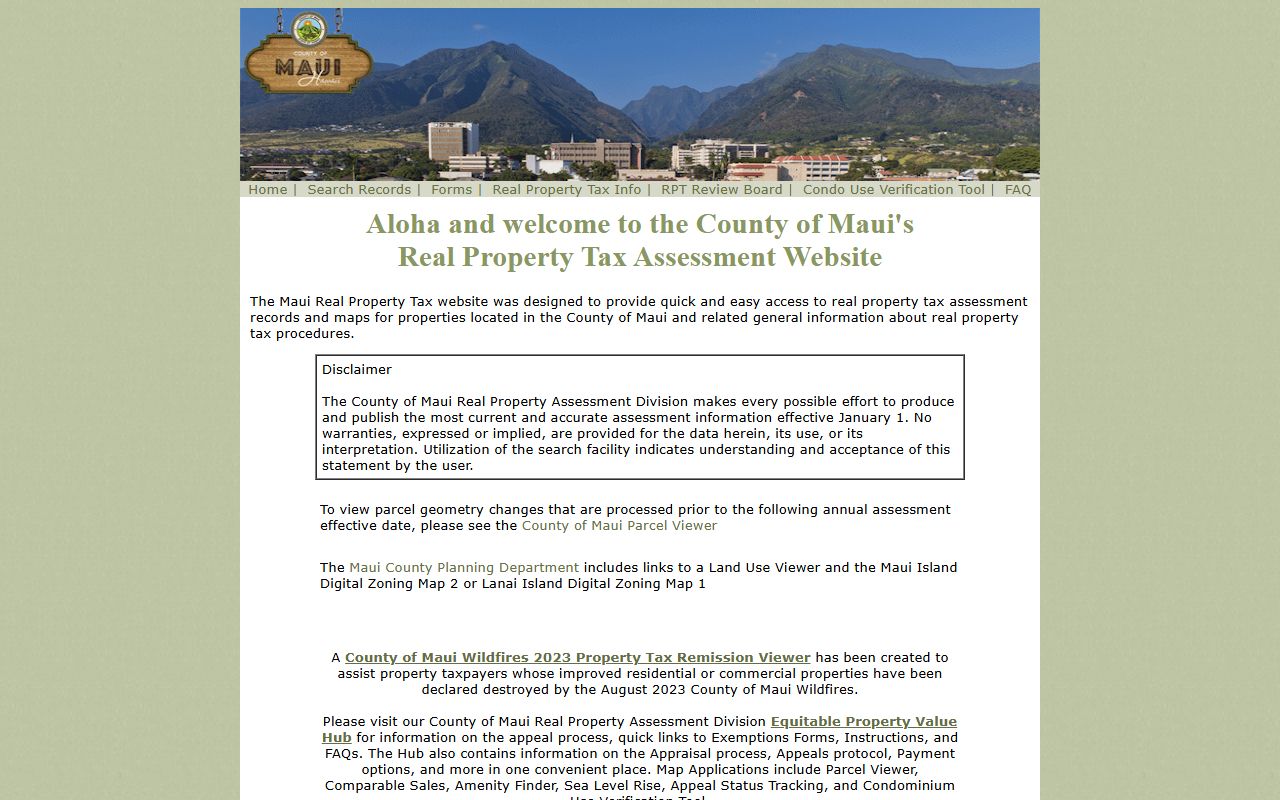
Kihei owners should review this rate schedule carefully because the classification assigned to their parcel, whether owner-occupied, non-owner residential, or short-term rental, determines which rate applies to their annual tax bill.
Appealing a Kihei Assessment
The appeal deadline in Maui County is April 9, following the March notice date. That is a short window. Do not wait to review your assessment notice when it arrives. If the value looks wrong, start gathering evidence right away. You need to file before April 9 or the right to challenge that year's assessment is gone. Kihei property values move with the vacation market and can shift significantly from year to year, so reviewing the notice every year is worth the few minutes it takes.
For Kihei condominium appeals, the best evidence is recent sales within your building or comparable buildings in the same part of Kihei. Sales of units with similar floor levels, view orientations, and square footage are the most persuasive comparables. If your unit has an obstructed view that you believe is not fully reflected in the assessment, photograph the view and document when the obstruction appeared. Changes in nearby development can affect view value and are not always captured immediately in assessments.
For vacation rental properties, if you believe the income assumptions used by RPAD do not match your actual rental experience, gather rental income records, occupancy data, and expense documentation. A property that generates less revenue than typical Kihei vacation rentals should not be assessed at the same value as one that is fully booked. Document the difference and present it clearly to the board.
The State of Hawaii Bureau of Conveyances records all conveyances under HRS Chapter 502. Their online records at boc.ehawaii.gov are useful when gathering comparable sales data for an appeal. You can search recent recorded deeds in the Kihei area to find actual sales prices and transaction dates, which is the raw data underlying any assessment challenge.
If the Maui County appeals board does not rule in your favor and you believe the decision was wrong, further review is available through the Hawaii State Tax Appeal Court. That process is more formal and requires filing in court. Most Kihei owners resolve disputes at the county level, but the state court option exists for cases where significant dollars are at stake and the county board decision does not hold up to scrutiny.
Maui County Property Tax Records
Kihei is in Maui County, and all property tax administration runs through the Maui County Real Property Assessment Division. The county page covers tax rates for all classifications, the full assessment methodology for residential and commercial properties, detailed appeal procedures, and every county-wide program that applies to Kihei parcels.
Nearby Cities
These Maui communities are near Kihei. Both are served by Maui County RPAD for property tax administration.