
Big Island Property Tax Records
Hawaii County property tax records cover all parcels on the Island of Hawaii, managed by the Real Property Tax Division through offices in both Hilo and Kailua-Kona. You can search these records online to find assessed values, ownership details, exemption status, and current tax amounts. This page explains how to look up Hawaii County property tax records, understand your assessment, apply for exemptions, and file an appeal if you think your value is wrong.
Hawaii County Overview
Real Property Tax Division Offices
Hawaii County runs two Real Property Tax Division offices, one in Hilo and one in Kailua-Kona. This setup reflects the Big Island's size and the fact that East Hawaii and West Hawaii are separated by the Kohala and Hualalai mountains. The Hilo office handles parcels in the Hilo, Hamakua, Puna, and Ka'u districts. The Kona office serves properties on the western side of the island, including the resort areas of Kohala Coast and the communities around Kailua-Kona. Staff appraisers in each office are assigned by district, so the person who handles your parcel depends on where it sits on the island. You can call or visit either office, but you may be directed to the one that covers your area.
The division maintains records for more than 170,000 parcels. That is a large workload for a county of this size, and field appraisers rotate through property inspections roughly every six to eight years. New construction gets added to the tax roll when certificates of occupancy are issued. Interior inspections only happen with the owner's permission or as part of an appeal review. The main division website is at hawaiipropertytax.com.
| Office | Hawaii County Real Property Tax Division (Hilo) |
|---|---|
| Address |
Aupuni Center 101 Pauahi Street, Suite 4 Hilo, HI 96720 |
| Hours | Monday through Friday, 7:45 AM to 4:30 PM |
| Website | hawaiipropertytax.com |
Both the Hilo and Kona offices keep the same hours. If you need to speak with the appraiser assigned to your parcel, the division allows you to schedule an appointment. This is worth doing if you have questions about how your value was set or want to prepare for an appeal. Walk-in visits are fine for general questions, but scheduled meetings give you more time with the right staff member.
The legal framework for Hawaii County property taxes falls under Hawaii Revised Statutes Chapter 246, which sets the state-level rules for real property taxation. County ordinances then set the actual rates and some local procedures. The Bureau of Conveyances, governed by HRS Chapter 502, records the deeds and transfers that feed ownership data into the tax roll.
The division's main website is the starting point for tax bills, assessment data, and exemption forms. Check there first before calling.
The Real Property Tax Division homepage gives you access to the online search tool, exemption forms, tax rate schedules, and key deadline dates. The screenshot below shows what the main site looks like.
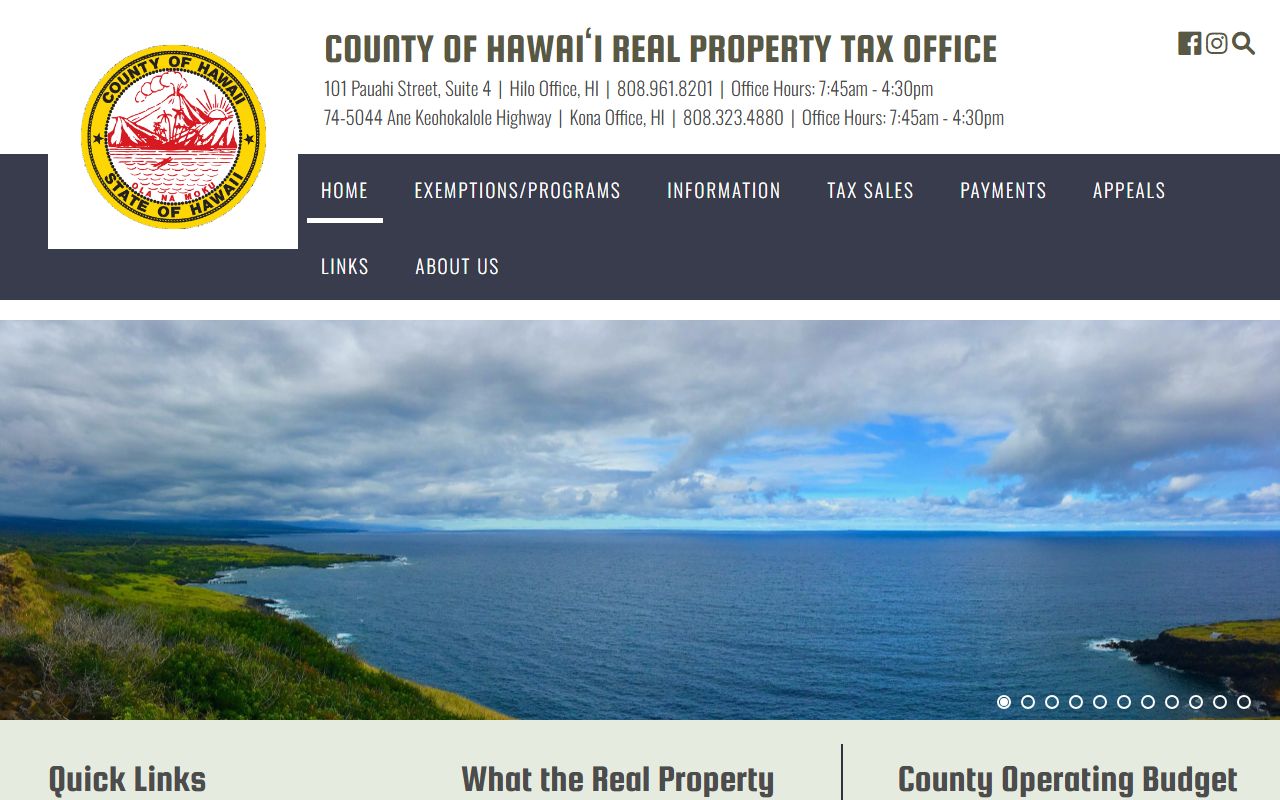
The site is well organized and easy to navigate from a desktop or phone.
How to Search Hawaii County Property Tax Records Online
The main online tool for Hawaii County property records is the qPublic portal at qpublic.net/hi/hawaii. This platform lets you search by Tax Map Key number, owner name, or property address. No login or fee is needed to use the basic search. Results come back quickly and give you a solid overview of any parcel in the county.
When you search by TMK, enter the nine-digit number without hyphens and without the island code prefix. Hawaii County parcels all start with the same island prefix, so the search tool does not need it. If you only have a partial TMK or an approximate address, searching by owner name is often easier. Name searches pull up all parcels tied to that person or entity in the county. You can then narrow down from there if someone owns multiple lots.
Each parcel record on qPublic shows several tabs of information. The main summary tab lists the current owner, mailing address, site address, land value, building value, any exemptions applied, property classification, and the current tax amount. The Improvements tab digs into building details: year built, living area in square feet, number of bedrooms and bathrooms, and construction class. The Sales tab is useful for research purposes, showing recorded transfers with document numbers, recording dates, and declared values going back several years. There is also a Comparable Sales feature that lets you pull recent sales near any subject parcel, which is useful if you are building a case for an assessment appeal.
Tax bills are viewable and printable as PDFs through the portal. Map-based search is also available, letting you click on parcel boundaries overlaid on aerial photography to pull up record detail. This is helpful when you know roughly where a property sits but not its exact address or TMK.
The screenshot below shows the qPublic search interface for Hawaii County.
The portal works on mobile, though the map feature is easier to use on a larger screen.
Public access to government records in Hawaii is governed by the Uniform Information Practices Act, found at HRS Chapter 92F. Property tax records are generally public, and the qPublic portal reflects that. You do not need to be the property owner to search or view parcel data.
Exemptions and Programs in Hawaii County
Hawaii County offers several exemptions that reduce the taxable value of a property or change its classification to a lower tax rate. The home exemption is the most widely used. It applies to owner-occupied residential properties used as the owner's principal home. The amount of the exemption scales up with age, which is a feature that benefits long-term residents and older homeowners in particular.
Here is the age-based home exemption scale for Hawaii County:
- Under age 60: $50,000 exemption
- Ages 60 to 64: $85,000
- Ages 65 to 69: $90,000
- Ages 70 to 74: $105,000
- Ages 75 to 79: $110,000
- Age 80 and over: $125,000
There is also an additional 20% exemption available, up to a maximum of $100,000, for owners who have held the home exemption for at least 10 years and have annual income under $100,000. To apply, you file Form 19-71 (Claim for Home Exemption) with the division. You need to provide proof of age and show that you file a Hawaii income tax return. The division cross-references Social Security numbers with state tax records to verify that the property is your primary residence. Only one home exemption is allowed per taxpayer across the entire state, not one per property.
The exemption deadline matters. You need to file by June 30 to get the benefit starting the following tax year. If you miss that window, you will not see the reduction until the next cycle. New owners should be aware that exemptions do not transfer when a property sells. The previous owner's exemption ends. You need to file your own claim. This applies to both the dollar exemption that reduces taxable value and the homeowner classification that locks in a lower tax rate and a 3% annual cap on assessed value increases. Both require separate applications.
Short-term rental activity disqualifies a property from the homeowner class. The division monitors this through advertising reviews and site visits. If a property is found to be operating as a short-term rental and was receiving homeowner class treatment, rollback taxes and penalties apply. Owners who rent their homes for periods under 180 days should not apply for the homeowner classification.
Other exemptions the county offers include a 100% exemption for totally disabled veterans (a minimum tax of $150 still applies), a $50,000 reduction for totally disabled non-veterans, and a similar $50,000 reduction for owners who are blind, deaf, or totally disabled. There is also a Native Forest Program that gives a 50% reduced assessment for properties with native forest conservation land. Details on all of these are at hawaiipropertytax.com/exemptions-programs.
The screenshot below shows the exemptions and programs page on the division's website.
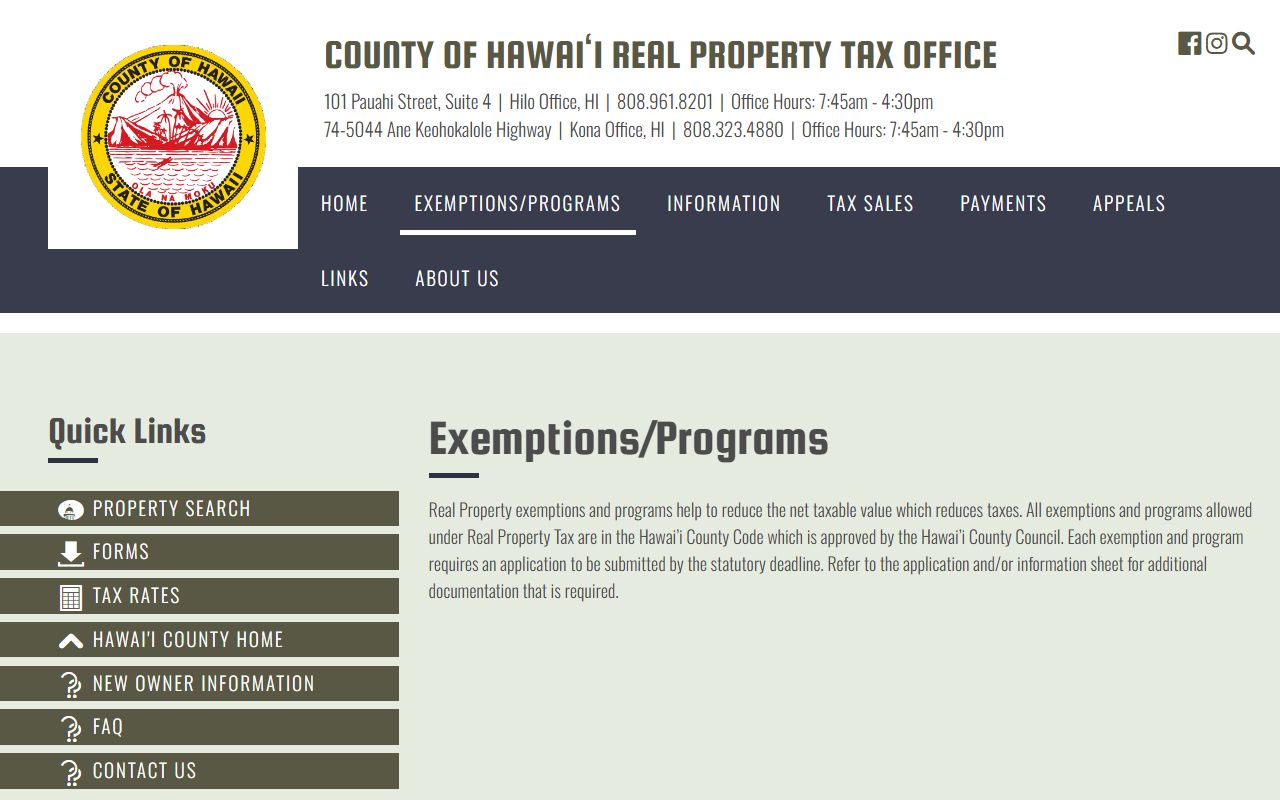
The page lists all current programs with links to the required forms.
Assessment Process and How to Appeal
Hawaii County sets assessed values as of January 1 each year. The division uses a Computer Assisted Mass Appraisal system, often called CAMA, to model values across the island's more than 170,000 parcels. The CAMA system uses sales data analysis, market modeling, land area, zoning, topography, building square footage, construction quality, age, condition, and recorded amenities to arrive at values. See the assessment page for more on how the process works.
Assessment notices go out by March 15. You have until April 9 to file an appeal, which is 30 days after the notice date. If you receive an amended notice, the 30-day clock restarts from that date. Missing the deadline is a hard stop. The division does not grant extensions as a general rule, so mark the date as soon as your notice arrives.
Grounds for appeal are limited to three things: the assessed value exceeds market value, the assessment is unequal compared to similar properties in the area, or an exemption was wrongly denied. The process starts with an informal review by appraisal staff. If that does not resolve the issue, you can request a formal Board of Review hearing. If you are still not satisfied after the Board's decision, you have 30 days to file with the Tax Appeal Court. Each appeal costs $50 per parcel as a filing fee. Gather sales data on comparable properties, recent appraisals, and any documentation about the condition of your property before you go in. The Comparable Sales feature on qPublic is a good starting point for pulling nearby sales data.
Key dates to keep on hand for Hawaii County property taxes:
- January 1: Assessment date (condition and ownership as of this date controls the year's value)
- March 15: Assessment notices mailed
- April 9: Appeal deadline
- June 30: Exemption filing deadline for first-half tax year benefits
- August 20: First-half payment due
- December 31: Exemption filing deadline for second-half benefits
- February 20: Second-half payment due
The tax year runs July 1 through June 30. The minimum tax is $200 per parcel. Specific current tax rates by property class can be confirmed at hawaiipropertytax.com. Rates are set per $1,000 of assessed value and vary by class: homeowner, residential non-homeowner, agricultural, commercial, and industrial each carry different rates.
Unique Considerations for Big Island Properties
Hawaii County has features that do not apply in any other county in the state. The most significant is lava zone designation. The island is geologically active, and the county assigns every parcel a lava zone number from 1 through 9. Zone 1 carries the highest volcanic risk. Zone 2 is also considered high risk. Properties in lower-numbered zones can face challenges with insurance, financing, and market value, and the division is supposed to reflect that risk in assessments.
The 2018 Kilauea eruption in lower Puna destroyed hundreds of properties. For parcels that were covered or damaged, the county applied specific relief procedures, including removal from the roll, reduced assessments, and in some cases complete exemption for tax years covering the destruction period. Owners whose properties suffered lava-related damage should verify that their current assessment accurately reflects post-eruption conditions. If you believe your assessment does not reflect damage or changed conditions, the appeal process described above is your path forward. Document the current state of the property with photographs and any independent appraisals you can get.
The Big Island spans a huge range of property types. Rural Ka'u has farm and ranch land assessed under agricultural rates. Kohala Coast has resort-zoned parcels with commercial values. Puna has a mix of rural residential lots and areas affected by lava. Hamakua has agricultural land with some of the oldest land records on the island. The diversity means there is no single typical parcel here, and understanding how your specific area and classification work is important for making sense of your assessment.
Historical property records for Hawaii County go back to the territorial period. The University of Hawaii at Hilo Edwin H. Mookini Library at hilo.hawaii.edu/library maintains historical assessment rolls, maps, photographs, and documents that can support research on older properties. If you are doing a title search or trying to trace ownership history on a rural Big Island parcel, this is a resource worth knowing about.
For deed and transfer records, the Bureau of Conveyances in Honolulu is the statewide recording office. All recorded instruments in Hawaii, including Hawaii County deeds, are searchable through the Bureau's online system. Transfer data from those recordings eventually feeds into the tax roll and shows up in the Sales tab on the qPublic portal. If you see a sale on your parcel's record that you did not expect, the Bureau of Conveyances system is where you can pull the actual document.
Cities in Hawaii County
Hawaii County covers the entire Big Island. Hilo is the county seat and the largest city on the island.
Other communities on the Big Island include Kailua-Kona, Waimea, Pahoa, and Naalehu. Property tax records for all communities on the island are held by the Hawaii County Real Property Tax Division.
Other Hawaii Counties
Hawaii has four counties. Property tax records in each county are managed by that county's real property tax office. Check the county where the property is located.