
Hilo Property Tax Records Search
Hilo property tax records are managed by Hawaii County, which covers the entire Big Island under one tax administration system. If you own a home or parcel in Hilo and need to look up your assessed value, check your exemption status, or review your current tax bill, the county's Real Property Tax Division handles all of that. The office serving East Hawaii is located right in Hilo at the Aupuni Center on Pauahi Street. Most searches can be done online through the county's public portal without ever setting foot in the building. This guide covers where to search, how the assessment process works, and what Hilo-area owners need to know about exemptions and lava zone considerations.
Hilo Overview
Hilo Real Property Tax Office
Hawaii County runs a single, island-wide tax system. There is no separate city tax office for Hilo. Instead, the Real Property Assessment Division operates two main offices: one in East Hawaii serving Hilo, Hamakua, Puna, and Ka'u, and one in West Hawaii serving Kona and the resort side of the island. If you own property in or near Hilo, the East Hawaii office is your point of contact.
You can call or visit to schedule a meeting with your district appraiser. Appointments are available for property owners who want to talk through their assessment in person. Walk-ins are accepted for general questions during regular business hours.
| Office | Hawaii County Real Property Tax Division (East Hawaii) |
|---|---|
| Address | Aupuni Center 101 Pauahi Street, Suite 4 Hilo, HI 96720 |
| Hours | Monday through Friday, 7:45 AM to 4:30 PM |
| Website | hawaiipropertytax.com |
The Aupuni Center is a county government hub that houses several departments. When you visit, bring any documents related to your property: your TMK number, a recent tax bill, or purchase paperwork. Staff can pull your record right away and answer most questions on the spot.
Search Hilo Property Tax Records Online
Hawaii County uses the qPublic platform for online property records access. It is free to use and does not require an account. You can search by TMK number, owner name, or street address. The system covers every parcel in Hawaii County, including all of Hilo and the surrounding East Hawaii districts.
When searching by TMK, enter the 9-digit number without hyphens and without the island code prefix. If you are not sure of the TMK, searching by street address usually gets you there faster. Owner name searches work well when you know the exact name on the deed, but they can return multiple results if the owner holds more than one parcel.
Each property record in the qPublic system shows a lot of useful data. You can see the land value and building value separately, along with the total assessed value. The record shows the current property classification, any exemptions applied, and a sales history going back several years. Tax bills are available as PDF downloads, which is convenient if you need a copy for a lender or estate matter. The system also has a map view that shows parcel boundaries with aerial photography layered underneath. For appeal preparation, the Comparable Sales feature lets you pull recent sales of nearby properties with similar characteristics.
The main county tax site at hawaiipropertytax.com is the starting point for most tasks. From there you can get to the qPublic search, the exemptions page, payment information, and contact details for both offices. The site is updated regularly and reflects the current tax year data.
The Hawaii County Real Property Tax Division maintains its main public-facing web presence at hawaiipropertytax.com, where you can find office locations, phone numbers, and links to the online search portal.
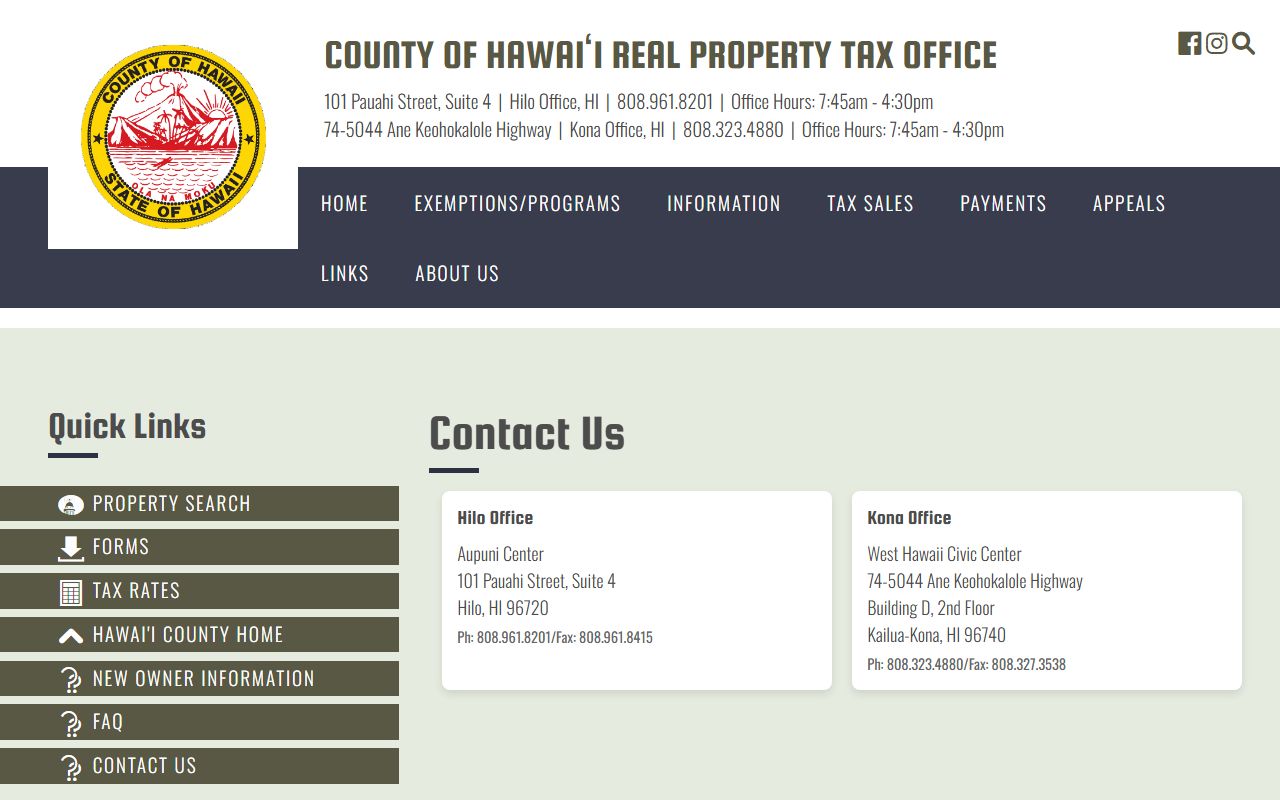
Both the East Hawaii and West Hawaii office addresses are listed on the contact page, along with department email contacts and links to the qPublic search tool.
Home Exemption for Hilo Residents
Hawaii County offers a home exemption that reduces the assessed value used to calculate your property tax bill. To qualify, the property must be your primary residence and you must have owned it as of January 1 of the tax year. The exemption amount goes up as you get older, which gives a bigger benefit to long-term residents who stay in their homes.
Here are the current age-based exemption amounts:
- Under age 60: $50,000
- Ages 60 to 64: $85,000
- Ages 65 to 69: $90,000
- Ages 70 to 74: $105,000
- Ages 75 to 79: $110,000
- Age 80 and over: $125,000
There is also an additional 20% exemption available. It applies to homeowners who earned less than $100,000 in the prior year and have held the home exemption for at least 10 consecutive years. The extra exemption is capped at $100,000 in value. Combined with the age-based exemption, long-term lower-income homeowners can reduce their taxable value significantly.
The deadline to file for the first time is June 30 if you want the exemption to apply to the first-half tax payment, or December 31 for the second-half benefits. New owners must file a new application. Exemptions do not transfer when a property changes hands. Details and the application form are on the county exemptions page. If you bought a home in Hilo and the previous owner had an exemption, that exemption ended at the sale. File as soon as you can after closing.
Lava Zones and Hilo-Area Property Assessment
One factor that sets Big Island property assessment apart from every other place in Hawaii is lava zone risk. The U.S. Geological Survey divides the island into nine lava zones based on the likelihood of lava flow. Zone 1 is the highest risk, Zone 9 the lowest. Parts of Hilo and much of the Puna district to the south sit in Zones 1 and 2.
The Real Property Assessment Division uses market data to set values, and that market data reflects lava zone risk. In practice, this means similar homes in lower-risk zones typically show higher assessed values than comparable homes in Zone 1 or 2. That can actually work in your favor as an owner in a higher-risk area, since your assessed value and your tax bill should reflect the market discount. But it also means if you are buying in Hilo or Puna, you need to understand that lower prices often come with higher insurance costs and potential limitations on utility service.
The 2018 Kilauea eruption in lower Puna destroyed roughly 700 homes and buried entire neighborhoods under lava. Hawaii County worked through specific assessment adjustments and relief measures for affected parcels. Some properties lost all value, others lost access, and a few were rebuilt. If you own land in an area affected by the 2018 eruption, verify that the county's records reflect the current status of the parcel. Reach out to the East Hawaii office if the assessment does not match what is actually on the ground.
Owners in lava-prone zones sometimes make improvements to make the property more resilient, like water catchment systems, off-grid power, or reinforced structures. These additions may be added to the assessed value as improvements, but they can also support the property's market value in a way that makes resale easier. Keep records of any major work you do, and check with the assessment office to make sure any new construction is properly documented on the tax roll.
Historical Property Records and UH Hilo Library
If you need to trace a property's history further back than the online records go, Hilo has a strong local research resource in the Edwin H. Mookini Library at the University of Hawaii at Hilo. The library's Hawaii Collection holds historical land documents, maps, photographs, and assessment rolls going back to the Territorial period, before Hawaii became a state in 1959.
Assessment rolls from earlier decades can help establish long-term value trends, verify historical ownership chains, and support probate or estate matters that involve older parcels. The Hawaii Collection is a specialized archive and staff can provide reference assistance. Not everything is digitized, so in-person research is sometimes the only way to find older records. The library's main site at hilo.hawaii.edu/library has contact information and guidance on accessing the collection.
For title research going further back, the Bureau of Conveyances in Honolulu holds all recorded deeds, mortgages, and land court documents statewide. Under Hawaii Revised Statutes Chapter 502, real property transfers must be recorded there to provide constructive notice. The bureau's online system lets you search recorded documents by name, document type, or land court application number. For Big Island properties, combining the Bureau of Conveyances records with the UH Hilo historical collection gives you the most complete picture of a parcel's history.
The Edwin H. Mookini Library at the University of Hawaii at Hilo offers access to the Hawaii Collection, which includes historical property records, assessment rolls, and land documents for Big Island research. Visit hilo.hawaii.edu/library for hours and contact information.

Reference librarians in the Hawaii Collection can assist with chain of title research, historical maps, and Territorial-era assessment records not available through the county's online portal.
Assessment and Appeals in Hawaii County
Hawaii County assesses all real property at 100% of fair market value as of January 1 each year. This is the standard under Hawaii Revised Statutes Chapter 246, which governs real property taxation statewide. The county uses a Computer Assisted Mass Appraisal system, often called CAMA, to produce assessed values at scale. Field appraisers rotate through properties on a cycle, inspecting each parcel roughly every six to eight years. New construction gets added to the roll as certificates of occupancy are issued.
Assessment notices go out by March 15. The appeal deadline is April 9. That window is short, so pay attention when the notice arrives. If you think your assessed value does not reflect what your property would actually sell for, you have a right to appeal. The appeal process starts with a written request to the Board of Review. You will need to support your position with evidence, such as a recent appraisal, comparable sales data, or documentation of property condition issues. The qPublic Comparable Sales tool is a good starting point for pulling recent sales in your neighborhood.
Older homes in Hilo sometimes have assessment problems that are worth checking. The CAMA system relies on data entered when the property was last inspected. If your home's living area is recorded incorrectly, or if the condition rating does not reflect deferred maintenance or damage, the assessed value could be too high. Pull your property record from the qPublic portal and check the building data. If the square footage, room count, or condition code seems off, that is worth raising in an appeal.
Key dates to keep in mind:
- January 1: Assessment date (value is based on market conditions as of this date)
- March 15: Assessment notices mailed
- April 9: Deadline to file a property tax appeal
- June 30: Exemption application deadline for first-half tax benefits
- August 20: First-half tax payment due
- December 31: Exemption deadline for second-half benefits
- February 20: Second-half tax payment due
The minimum tax in Hawaii County is $200 per year, regardless of assessed value. That applies even to low-value parcels. If your tax bill seems wrong after an assessment, contact the East Hawaii office before the April 9 deadline. Missing that date means waiting another year to challenge the value. The county's website at hawaiipropertytax.com has the appeal forms and instructions.
Hawaii County Property Tax Records
Hilo is the county seat of Hawaii County, and the county's Real Property Assessment Division administers all property tax for the entire Big Island. That includes Hilo and Hilo-area neighborhoods as well as the Hamakua Coast, Puna, Ka'u, and the Kona side of the island. For a full breakdown of the county tax system, rates, exemption programs, and office information, visit the Hawaii County property tax records page.