
Find Kauai County Property Tax Records
Kauai County property tax records are maintained by the Real Property Assessment Division in Lihue. The county covers the island of Kauai, with roughly 32,000 taxable parcels ranging from resort properties on the North Shore to agricultural land near Kilauea. You can search records online through the qPublic portal or visit the office in person. Kauai uses a detailed "actual use" classification system that sets it apart from most counties in Hawaii. This page explains how to find records, how properties get classified, and what exemptions may apply to your parcel.
Kauai County Overview
Kauai County Real Property Assessment Division
The Real Property Assessment Division is part of the Kauai County Department of Finance. It handles all functions related to property tax records: assessment of land and improvements, exemption processing, and collections. The office is in Lihue, which serves as the county seat for the island.
Staff can help you look up a parcel, check your assessment, file an exemption, or find out how your property is classified. Public access computers are available at the office if you want to search records on-site. For complex matters like classification changes or disputed assessments, the office recommends calling ahead to set up an appointment. Copy services cost $1 per page for assessment records. You can pay in cash, check, or money order at the office. Credit cards are accepted only for online payments.
You can reach the office by email at finance.rp@kauai.gov for general questions. The department's main real property tax page at kauai.gov lists current forms, fee schedules, and program details.
| Office | Kauai County Real Property Assessment Division |
|---|---|
| Address |
4444 Rice Street, Suite 150 Lihue, HI 96766 |
| Phone | (808) 241-4224 |
| Fax | (808) 241-6507 |
| finance.rp@kauai.gov | |
| Hours | Monday through Friday, 8:00 AM to 4:00 PM (closed holidays) |
| Website | kauai.gov Real Property Tax |
The division above is where the screenshot below was captured. The page lists direct links to the search portal, exemption applications, tax class rules, and billing information.
The Kauai County Real Property Tax Division website is the starting point for most records requests. The screenshot below shows the main page as it appears to the public.
Source: Kauai County Real Property Tax Division
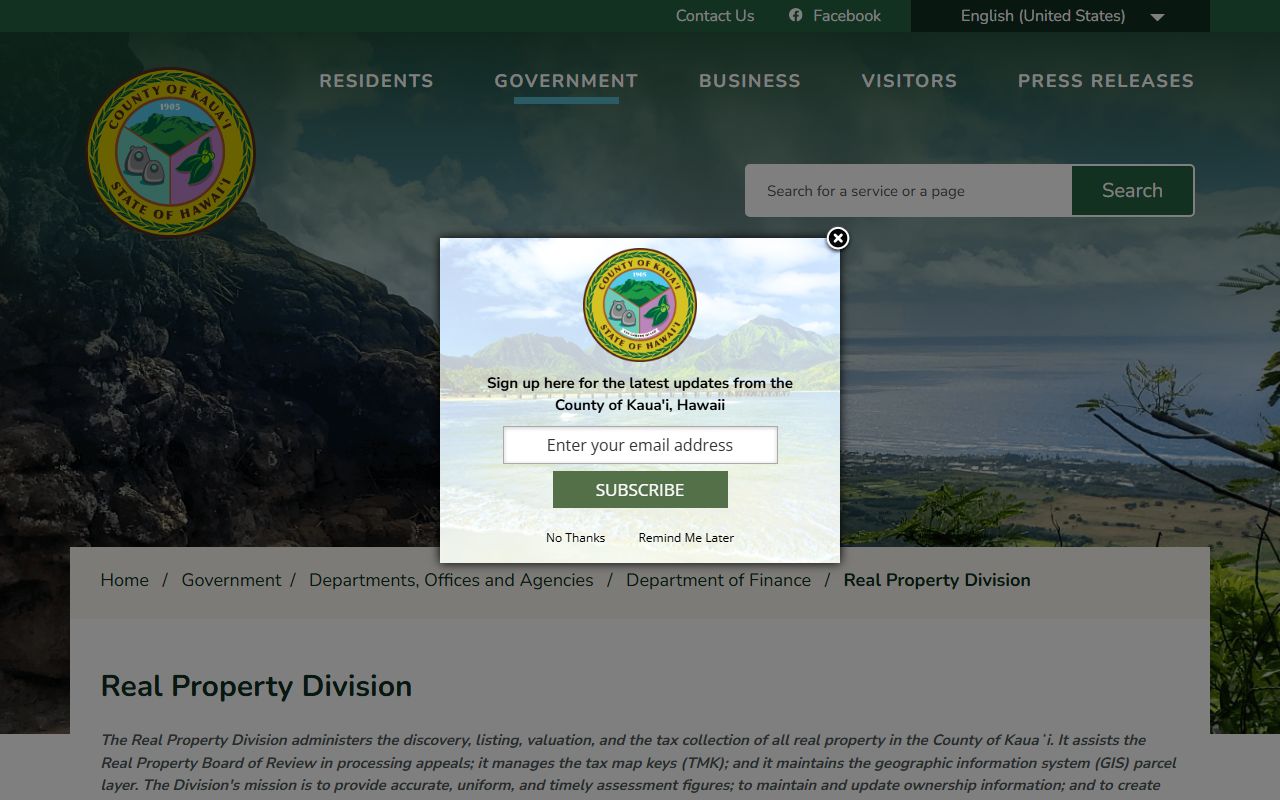
The division's website provides access to the qPublic search portal, exemption forms, tax classification rules, and contact details for all three sections: Assessment, Exemptions, and Collections.
Search Kauai County Property Tax Records Online
Kauai County uses the qPublic platform to give the public online access to property records. The portal is free to use and does not require an account. You can search by Tax Map Key (TMK), owner name, or property address. Search results show the land use classification, building area, year built, and sales history for each parcel.
The qPublic system integrates with Kauai's GIS mapping. Once you find a parcel, you can view its boundaries overlaid on aerial photography. This can help you verify you have the right property before ordering copies or filing an appeal. Keep in mind that the GIS parcel boundaries shown are for visual reference only. They are not legal survey-quality lines. Improvement records in the system are based on inspections and may not reflect all current permits or variances on a property.
The 9-digit TMK is the most reliable way to search. If you only have an address, the portal can still find the parcel in most cases. Owner name searches work well when a property has not changed hands recently. The portal also includes a Tax Classification section that explains how actual use determines which rate applies to a given parcel.
Source: qPublic Kauai County Property Search
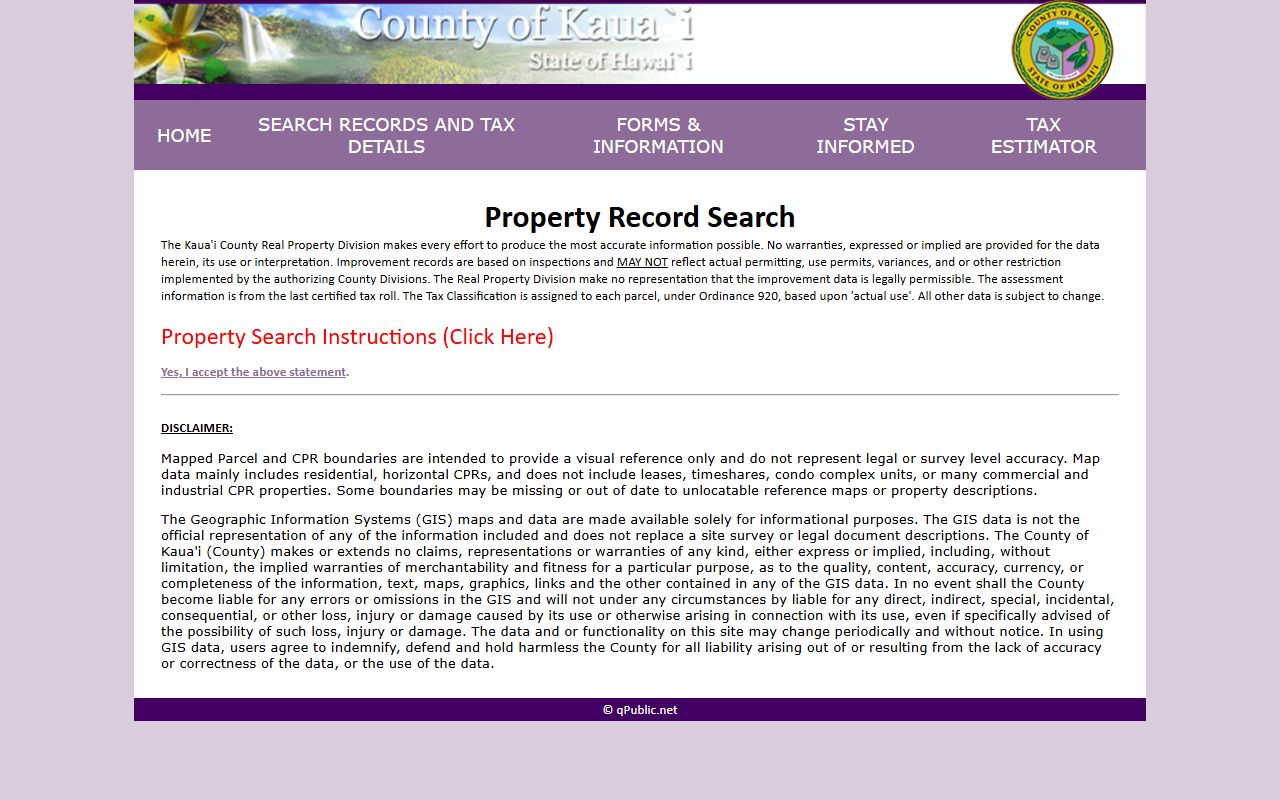
The qPublic portal allows searches by TMK number, owner name, or address. Results include classification, building data, sales history, and a GIS map of the parcel boundaries.
If you find an error in the portal data, there is a feedback mechanism built into the system. You can flag data issues directly from the parcel page. The Assessment Division reviews these reports and updates records when corrections are warranted. Under Hawaii Revised Statutes Chapter 246, property owners have specific rights to review and challenge assessment data, and the portal is often the first step in that process.
Kauai's Actual Use Classification System
Kauai County classifies property based on actual use as of January 1 each year. This is different from how many counties handle it. The county adopted Ordinance 920, which sets out detailed rules for determining which tax class applies. The classification drives the tax rate, so getting it right matters. A vacation rental property pays a different rate than a long-term rental or an owner-occupied home.
The county's administrative rules define specific use categories. The full rule document is available at kauai.gov. The main classifications are: Residential, Vacation Rental (rentals under 180 days), Commercial, Industrial, Agricultural, Conservation, Hotel/Resort, Homestead (owner-occupied with home exemption), and Residential Investor (non-owner-occupied properties valued over $1.3 million).
Changing a property's classification is not a simple process. The rules require that the prior use has fully stopped. That means removing signage and advertisements, canceling relevant permits, getting acknowledgment from the Planning Department, submitting a completed Use Survey, and filing an owner affidavit. For a vacation rental converting to residential, the owner must also forfeit the transient vacation non-conforming use permit, show proof of the last booking date, and cancel the Transient Accommodations Tax license. A current long-term lease is also required. These steps exist to prevent owners from switching classifications temporarily to get a lower tax rate and then reverting.
The Real Property Use Survey is the primary tool for establishing or verifying a property's classification. The survey form is available at kauai.gov. It asks about property type, current use, occupancy status, number of units, and rental details. For rentals, you specify whether they are short-term (under 180 days) or long-term (over 180 days). For agricultural properties, the form asks about farming activities, crops or livestock, and agricultural income. For commercial properties, it covers business type, signage, parking, and operating hours. The survey is filed under penalty of perjury. False statements can result in back taxes and penalties. Submit the completed survey by September 30 for the change to take effect in the following tax year.
Under HRS Chapter 246, the county has authority to set tax classes and rates within the framework the state provides. Kauai has used that authority to build one of the more detailed classification systems in the state, particularly around vacation rentals and investor-owned properties. This reflects the county's effort to distinguish between owner-occupied homes, long-term rentals, and short-term vacation properties that serve a different market.
Home Exemption and Tax Relief Programs
Kauai County offers several programs that reduce property tax for qualifying owners. The Home Exemption is the most widely used. Owners under age 60 who live in their home as their primary residence get a $160,000 reduction in assessed value. Owners age 60 and older get a $200,000 reduction. The exemption must be filed with the Assessment Division and is applied each year going forward once approved. The deadline to file or update an exemption is December 31.
The Disability Exemption provides a $50,000 reduction in assessed value for owners who are totally disabled. This is separate from the Home Exemption and can be applied in addition to it if the owner qualifies for both.
One program unique to Kauai is a low-income homeowner benefit for long-term residents. Qualifying owners must have held the Home Exemption for at least 10 consecutive years and have gross income of $200,000 or less. They must not own any other real property. These owners pay the higher of 3% of gross income or $500 annually, regardless of the normal tax calculation. This must be filed each year. It does not apply automatically. The program is designed to help longtime owner-occupants who face rising assessments but have modest income.
The Long-Term Affordable Rental program gives benefits to property owners who rent at rates affordable to households earning 90% or less of Kauai's Median Household Income. This encourages more affordable long-term housing options on the island. The tax benefit can be meaningful for landlords who participate, and the program is a response to the island's housing cost pressures.
The basic tax calculation for any parcel is: (Total Assessed Value minus Exemptions) divided by 1,000, multiplied by the applicable Tax Rate. Details on all exemption programs, including current forms, are at kauai.gov.
Source: Kauai County Homeowner Exemption and Tax Relief Programs
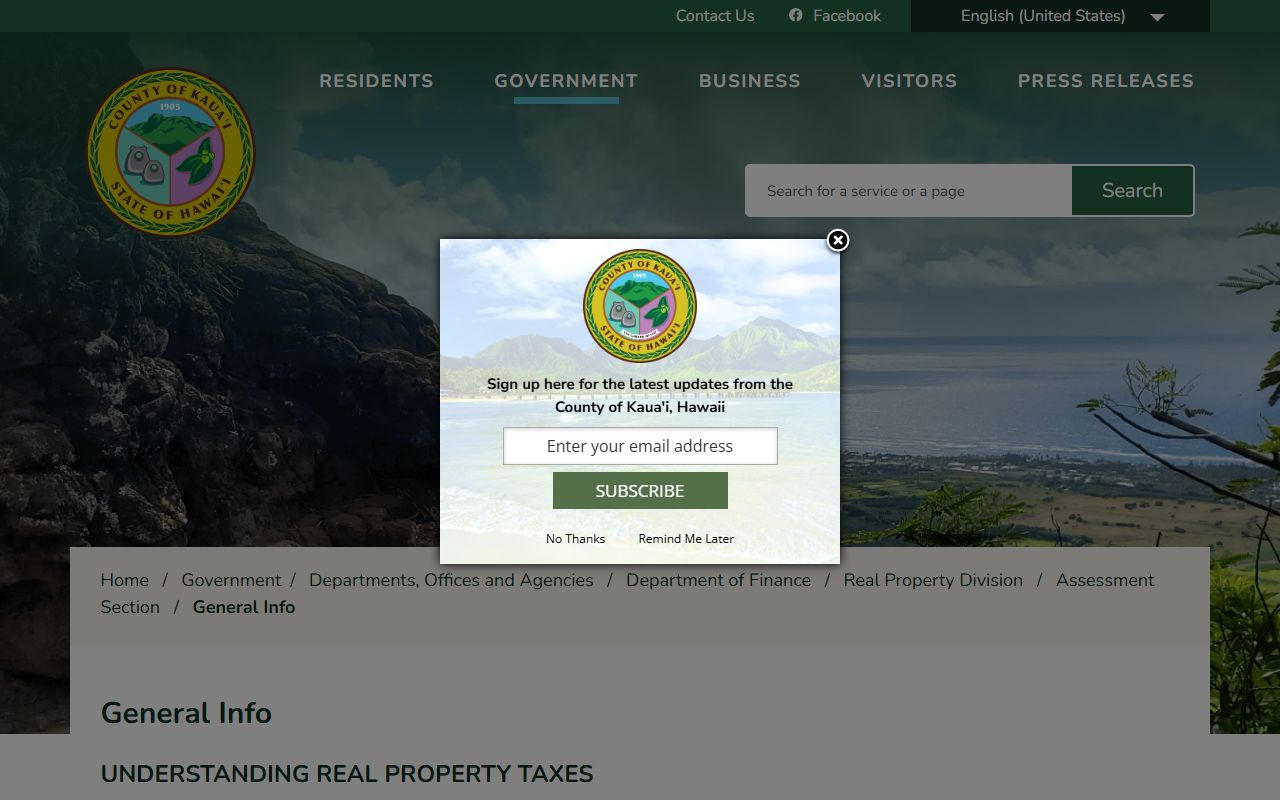
The Assessment Division's General Info page covers Home Exemptions, the low-income homeowner program, Long-Term Affordable Rental benefits, and the Disability Exemption, along with current forms and deadlines.
Assessment Process and How to Appeal
All properties in Kauai County are assessed at 100% of fair market value. The assessment date is January 1 each year. That means the value on your notice reflects what your property was worth on January 1, not when the notice was mailed. Assessment notices go out on December 1. You have until December 31 to file an appeal. That is the same deadline as the exemption filing deadline, so December is a busy time for the Assessment Division.
The appeal process starts with a written appeal filed with the Board of Review. You must include your reasons for disputing the assessed value and any supporting evidence, such as a recent appraisal or comparable sales data. The Board holds hearings and issues a decision. If you are not satisfied with the Board's ruling, you can appeal further to the Tax Appeal Court under HRS Chapter 246. That court handles property tax disputes across the state.
Property records, including recorded deeds and tax map information, are also maintained under HRS Chapter 502, which governs the state's land court and regular system for recording instruments. If you need to check ownership history or verify a deed, those records are at the Bureau of Conveyances in Honolulu for properties recorded statewide.
Key dates to keep in mind for Kauai County property taxes:
- January 1: Assessment date for the tax year
- September 30: Deadline to submit a Use Survey for the following tax year
- December 1: Assessment notices mailed to property owners
- December 31: Deadline for both appeals and new exemption filings
- July 1: Tax year begins
- August 20: First-half tax payment due (bills mailed July 20)
- February 20: Second-half tax payment due (bills mailed January 20)
If you miss the December 31 appeal deadline, options are very limited. The county does not grant extensions as a routine matter. If you believe there is an error in your assessment, act quickly after you receive your notice. The office can sometimes resolve clear data errors, such as a wrong building size or land area, outside the formal appeal process. Call the Assessment Division at (808) 241-4224 first to ask whether your issue can be corrected administratively before filing a formal appeal.
Tax bills go to the address on file with the Assessment Division. If you have recently purchased property or moved, make sure the office has your current mailing address. Not receiving a bill does not excuse a late payment. Taxes are still due on the dates above, whether or not you got the bill. Late payments accrue penalties and interest under the county's collections rules.
Cities in Kauai County
Kauai County does not have any incorporated cities that meet the population threshold for this project. Communities on the island include Lihue, Kapaa, Waimea, Hanapepe, Koloa, and Princeville, but none qualify as major cities by population. If you own property anywhere on Kauai, your records are at the Assessment Division in Lihue. All searches start at the county level using the portal above.
Other Hawaii Counties
Hawaii has four counties. Each one maintains its own property tax records. If your property is on a different island, use the links below to find the right county page.