
Urban Honolulu Property Tax Records Search
Urban Honolulu property tax records are maintained by the Honolulu County Real Property Assessment Division, which covers every parcel in the urban core including downtown Honolulu, Waikiki, Ala Moana, and Kakaako. The RPAD online portal lets you search assessed values, tax bills, ownership information, and exemption status for any of the roughly 45,000 parcels in this area. Property values here are the highest in Hawaii, and the tax rules that apply to high-value residential properties make it especially important for owners to understand how their parcel is classified and what exemptions they may qualify for.
Urban Honolulu Overview
Where Property Tax Records Are Kept for Urban Honolulu
All property tax records for Urban Honolulu are held by the City and County of Honolulu's Real Property Assessment Division, known as RPAD. This office handles assessment, classification, exemptions, and the tax roll for every parcel in Honolulu County, which means it covers the entire island of Oahu including Urban Honolulu. There is no separate city-level tax office. RPAD is your single point of contact for anything related to property taxes in this area.
The RPAD main office is at 842 Bethel Street, Basement, Honolulu, HI 96813. You can reach them by phone at (808) 768-3799. Office hours are Monday through Friday, 7:45 AM to 4:30 PM. Walk-in visits are accepted during those hours, and staff can help you look up parcel data, review your assessment notice, or pull records for a specific TMK number.
| Office | Honolulu County Real Property Assessment Division (RPAD) |
|---|---|
| Address | 842 Bethel Street, Basement Honolulu, HI 96813 |
| Phone | (808) 768-3799 |
| Hours | Monday through Friday, 7:45 AM to 4:30 PM |
| Main Portal | realproperty.honolulu.gov |
| Property Search | qpublic.honolulugov.org |
The primary online search tool is the qPublic database at qpublic.honolulugov.org. You can search by TMK number, owner name, or address. Results show the current assessed value, classification, tax rate tier, any exemptions on file, and the annual tax bill amount. The RPAD main portal at realproperty.honolulu.gov has additional resources including forms, appeal instructions, exemption applications, and the full tax rate schedule. Both are free to use and do not require an account.
Property tax in Hawaii is governed by Hawaii Revised Statutes Chapter 246, which sets out the framework for real property taxation statewide. Ownership and deed records are maintained separately by the Bureau of Conveyances under HRS Chapter 502, but RPAD pulls from that data to keep its ownership records current. If you recently purchased a property and the records still show the prior owner, the transfer may not yet have processed through the Bureau of Conveyances.
Condominiums and Urban Honolulu Property Tax Records
Urban Honolulu has a very high concentration of condominium units, and searching tax records for condo properties works differently than searching for single-family homes or land parcels. Each condominium unit in a Condominium Property Regime (CPR) is assigned its own Tax Map Key number. The standard TMK format in Hawaii has five components separated by hyphens (zone, section, plat, parcel, and CPR). For condo units, a sixth component is added to identify the specific unit. When you search for a condo, you need to enter the full TMK including that sixth part, or your search may return the land parcel for the entire building rather than the individual unit you want.
High-rise buildings in downtown Honolulu, Ala Moana, and Waikiki can have hundreds of units all tied to a single parent land parcel. RPAD assesses each unit individually. The factors used in that individual assessment include the interior square footage, the floor level, the view from the unit, building amenities, and the overall condition of the unit. Common elements like the lobby, pool, parking structure, and landscaped grounds are factored into each unit's value rather than assessed separately. This means two units of the same size in the same building can carry significantly different assessed values depending on their floor level and view corridor.
Ocean view units in Waikiki and Ala Moana high-rises often carry assessed values 20 to 40 percent higher than interior units of the same square footage in the same building. Higher floors also command premium assessments. If you own a condo and plan to appeal your assessment, you should pull comparable sales data from units within the same building first, then expand to nearby similar buildings if the same-building comparables are insufficient. Broad neighborhood comparisons are less persuasive for condos because floor level and view differences make unit-to-unit comparisons unreliable across different addresses.
The RPAD portal lets you search by unit address or by the full TMK. If you are buying a condo and want to check the current tax bill before closing, search the full TMK on the qPublic database. The record will show the current assessed value, the classification in use, and whether a home exemption is active. If the seller had a home exemption, that exemption does not transfer. New owners must file their own exemption application after taking title.
Residential A Classification in Urban Honolulu
The Residential A classification is one of the most important tax rules for Urban Honolulu property owners to understand. It applies to residential properties with an assessed value over $1,000,000 that do not have a home exemption on file. Given that median condo values in Urban Honolulu exceed $500,000 and that many units and virtually all single-family homes in desirable areas are valued well above $1 million, a large share of properties in this area fall under this classification. More information on the classification is available at the RPAD Residential A page.
The Residential A rate applies in two tiers. For the portion of value from $1,000,000 to $1,500,000, the rate is $4.50 per $1,000 of assessed value. For the portion of value above $1,500,000, the rate climbs to $9.00 per $1,000. The standard Residential rate for properties with a home exemption is $3.50 per $1,000. The math makes the difference very clear. A property assessed at $2,000,000 without a home exemption will owe approximately $15,000 per year in property tax under the Residential A tiers. The same property with a home exemption would be taxed at the standard Residential rate, producing a bill of roughly $6,650. That gap of more than $8,000 per year is why filing for the home exemption promptly matters so much in Urban Honolulu.
New buyers are the group most at risk of landing in Residential A without realizing it. If you purchase a property and the prior owner had a home exemption, that exemption ends at sale. Your first assessment cycle as the new owner will likely show no exemption, pushing a high-value property into Residential A. The exemption filing deadline is September 30. If you close on a purchase in the summer, you may have only weeks to file before the deadline passes for that cycle.
Investors and second-home owners who do not qualify for the home exemption will always pay under the Residential A rate if their property clears the $1,000,000 threshold. That is simply the classification that applies. For those owners, knowing the rate structure in advance is necessary for accurate underwriting and cash flow planning.
Kakaako, Waikiki, and Special Tax Considerations
Two neighborhoods within Urban Honolulu carry additional layers of complexity for property tax purposes: Kakaako and Waikiki. Owners in both areas should be aware of how their specific situation may differ from the general rules that apply elsewhere in Honolulu County.
Kakaako is governed in part by the Hawaii Community Development Authority (HCDA), which has jurisdiction over land use planning and development in that district rather than the standard city zoning framework. HCDA's offices are at 461 Cooke Street in Honolulu. Properties in the HCDA district may carry special assessments tied to development agreements, or they may benefit from tax incentive structures negotiated as part of those agreements. Affordable housing agreements in particular can run with the land for 30 to 55 years. If you own or are buying a unit in a newer Kakaako high-rise, it is worth checking whether any affordable housing agreement applies to the unit, since those agreements can restrict resale prices and rentability in ways that also affect assessed value. Owners in recently completed buildings should also confirm that the TMK has been properly updated to reflect the completed structure rather than the vacant land or construction-phase assessment.
Waikiki is Honolulu's primary visitor accommodation zone, and many properties there operate as legal vacation rentals, timeshares, or hotels. The tax classification applied to a property depends on its actual use and whether it holds a valid permit from the Department of Planning and Permitting. Hotel and resort-classified properties carry rates approximately four times higher than the standard Residential classification. RPAD coordinates with Planning and Permitting to identify properties operating as transient vacation rentals without the required permit. Properties flagged in that review can face reclassification and back taxes covering prior tax years. If you own a unit in Waikiki and rent it out on a short-term basis, your permit status directly affects your tax classification and bill.
Residential properties in Waikiki also routinely face Residential A classification due to the high assessed values in that corridor. The combination of high base values, potential Residential A rates, and the risk of reclassification for unpermitted rental activity makes Waikiki one of the more complex areas for property tax compliance in all of Hawaii.
The RPAD portal is the starting point for verifying any property's current classification. The qPublic database at qpublic.honolulugov.org shows the classification code assigned to each parcel. If the code does not match what you expect given how the property is used, contact RPAD directly to ask about the basis for the current classification.
The RPAD main portal provides a clear visual overview of how classifications and rates are structured. The screenshot below, sourced from the RPAD Residential A page, illustrates the Residential A classification details that affect high-value properties throughout Urban Honolulu.
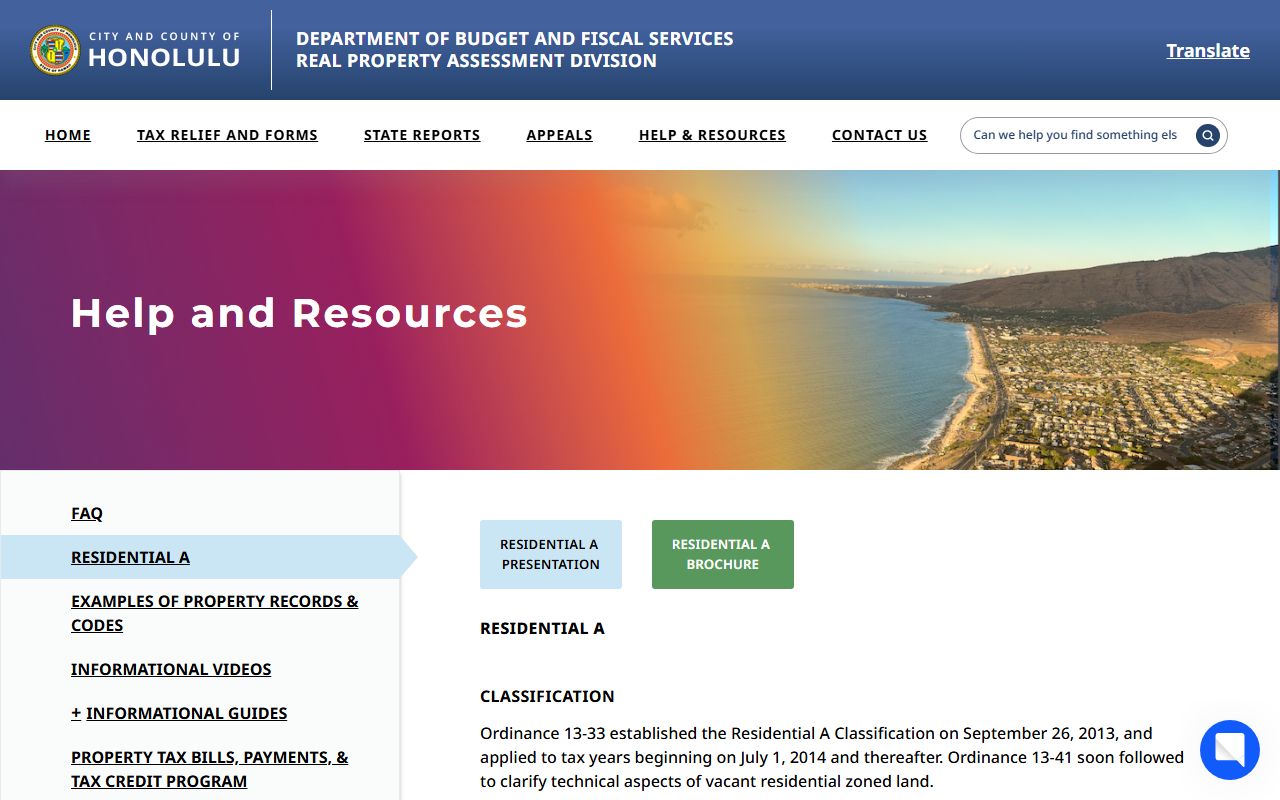
The Residential A page on the RPAD site breaks down both rate tiers and includes examples that help owners calculate what they owe based on their assessed value and exemption status.
Home Exemption and Appeals for Urban Honolulu Owners
Two actions have the biggest direct impact on how much property tax an Urban Honolulu owner pays each year: filing the home exemption and appealing the assessed value if it is inaccurate. Both have firm deadlines, and missing them means waiting another full year before the correction takes effect.
The home exemption reduces the assessed value used to calculate your tax bill. For owners under age 65, the current exemption amount is $120,000, rising to $140,000 on July 1, 2027. For owners age 65 and older, the exemption is $160,000, rising to $180,000 on July 1, 2027. To qualify, the property must be your principal residence and you must own it. You file using Form BFS-RPA-E-8-10.3, and the deadline is September 30. Full details on eligibility and the application process are on the RPAD home exemption page. Once approved, the exemption renews automatically as long as your use of the property does not change. You do not re-file every year unless your situation changes or you move.
Assessment notices go out on December 15 each year. When you receive your notice, check the assessed value against what comparable properties in your building or neighborhood have been assessed at. If the value looks high, you have from December 15 through January 15 to file an appeal. That is a short window. More information on the appeal process, including forms and instructions, is at the RPAD appeals page. For condo owners, the strongest appeal evidence comes from sales of comparable units in the same building during the period close to the October 1 assessment date.
The RPAD FAQ covers common questions about deadlines, payment schedules, and how to read your assessment notice. You can find it at the RPAD FAQ and important dates page. Tax payments are due in two installments: the first half is due August 20 and the second half is due February 20. The tax year runs July 1 through June 30.
The RPAD main portal, shown in the screenshot below from realproperty.honolulu.gov, is the hub for all of these tasks. It gives Urban Honolulu owners access to parcel searches, exemption forms, appeal information, and the current tax rate schedule in one place.
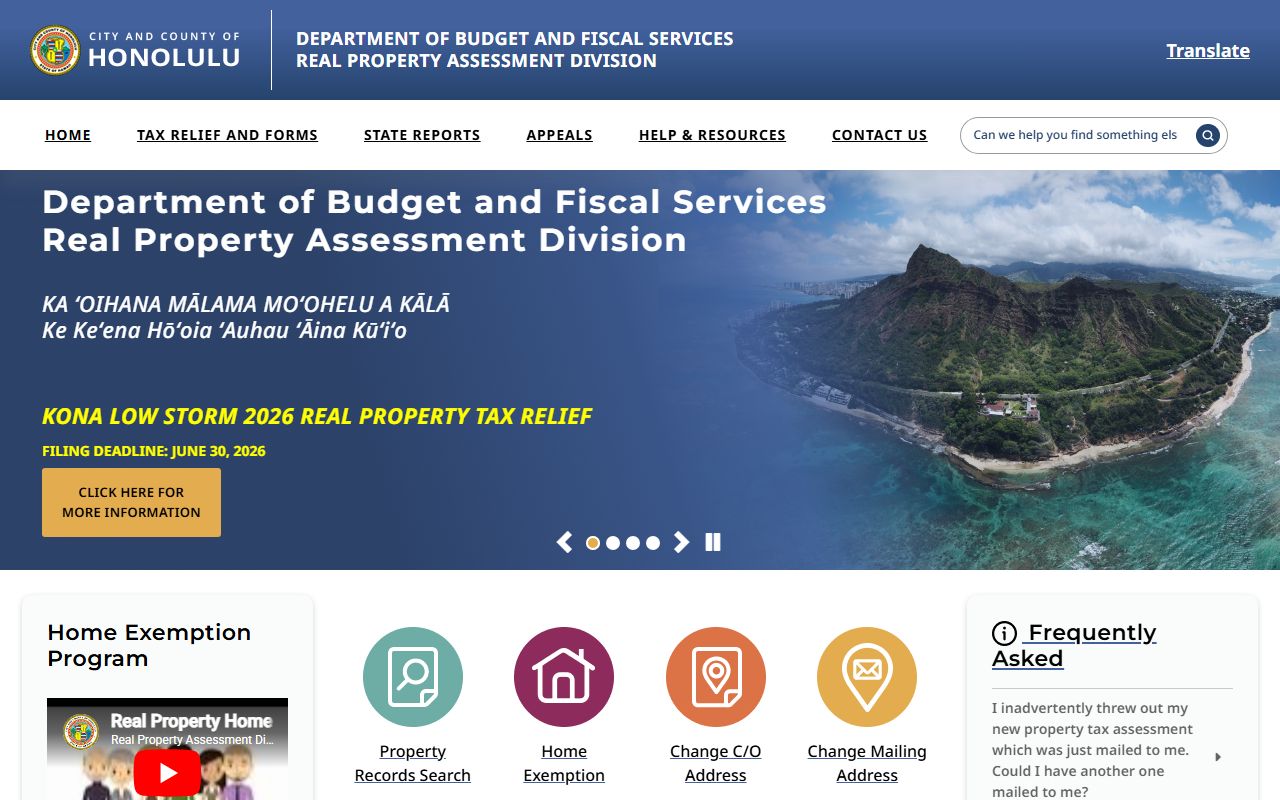
Bookmarking the RPAD portal is practical for any Urban Honolulu property owner. Key dates and forms are updated there each year, and the parcel search database is the fastest way to check your current assessment without calling or visiting the office.
Honolulu County Property Tax Records
Urban Honolulu is part of the City and County of Honolulu, and all property tax records for this area go through the same county RPAD office. The Honolulu County property tax records page covers the full county system, including tax rates, all classification types, and resources for properties outside the urban core.
Nearby Cities
These cities are also on Oahu and use the same Honolulu County RPAD system for property tax records.