
East Honolulu Property Tax Records
East Honolulu property tax records are managed by the Honolulu County Real Property Assessment Division, which handles all assessments, exemptions, and appeals for communities like Kahala, Hawaii Kai, Aina Haina, and Niu Valley. Because East Honolulu includes some of the most valuable residential land on Oahu, many owners here face higher tax bills than in other parts of the island, and knowing how the system works can help you check your assessment, spot errors, and file on time if something looks wrong.
East Honolulu Overview
Property Tax Records for East Honolulu
All property tax records in East Honolulu fall under Honolulu County. The Real Property Assessment Division, known as RPAD, is the office that sets assessed values, processes exemption applications, and handles appeals. There is no separate city tax system here. Every parcel in East Honolulu is tracked by the county, and Honolulu County is the only jurisdiction that levies real property tax in this area.
You can look up records online through two portals. The main RPAD site is at realproperty.honolulu.gov, where you can find general info, forms, and appeal details. For actual parcel searches, use qpublic.honolulugov.org. That tool lets you search by Tax Map Key number, property address, or owner name. Once you pull up a record, you can see the assessed land value, building value, total value, and the tax class assigned to the parcel.
The Tax Map Key, often called a TMK, is the unique identifier for every parcel in Hawaii. For East Honolulu, TMK numbers typically start with the division prefix for this part of Oahu. If you know your TMK from a deed or prior tax bill, searching by that number is the fastest way to find your record. Address searches also work, though street naming can vary from what you expect.
RPAD's main office is at 842 Bethel Street, Basement, Honolulu, HI 96813. Phone is (808) 768-3799. They are open Monday through Friday, 7:45 AM to 4:30 PM. You can also reach staff by email at bfsrpmailbox@honolulu.gov. If you have a specific question about your parcel's record, calling or emailing ahead can save a trip downtown.
Records from prior years are also available. If you're trying to trace ownership history or see how an assessed value changed over time, RPAD can help. Some older records may require an in-person visit rather than an online lookup. Staff can pull historical assessment data and print records on request.
Hawaii Kai Marina and Property Values
Hawaii Kai has a feature found almost nowhere else in Honolulu: a marina system with private boat docks attached to residential lots. Some homes in Hawaii Kai come with deeded dock rights, and those rights carry real assessed value. RPAD treats dock access as part of the property, so a parcel with a valid slip can show a significantly higher assessed value than a nearby home without one.
Dock rights can add anywhere from $50,000 to $200,000 or more to an assessed value, depending on the slip size and location within the marina system. That added value means a higher tax bill each year. If you own a marina-adjacent property and your dock access has been lost, encumbered, or is otherwise no longer usable, that change should be reflected in your assessment. If it isn't, you have grounds to raise the issue in an appeal.
The source below shows the Hawaii Kai Marina Association's website, which manages the marina network and its private roads and common areas. Reviewing this resource can help you understand how dock rights are structured and what the association maintains.
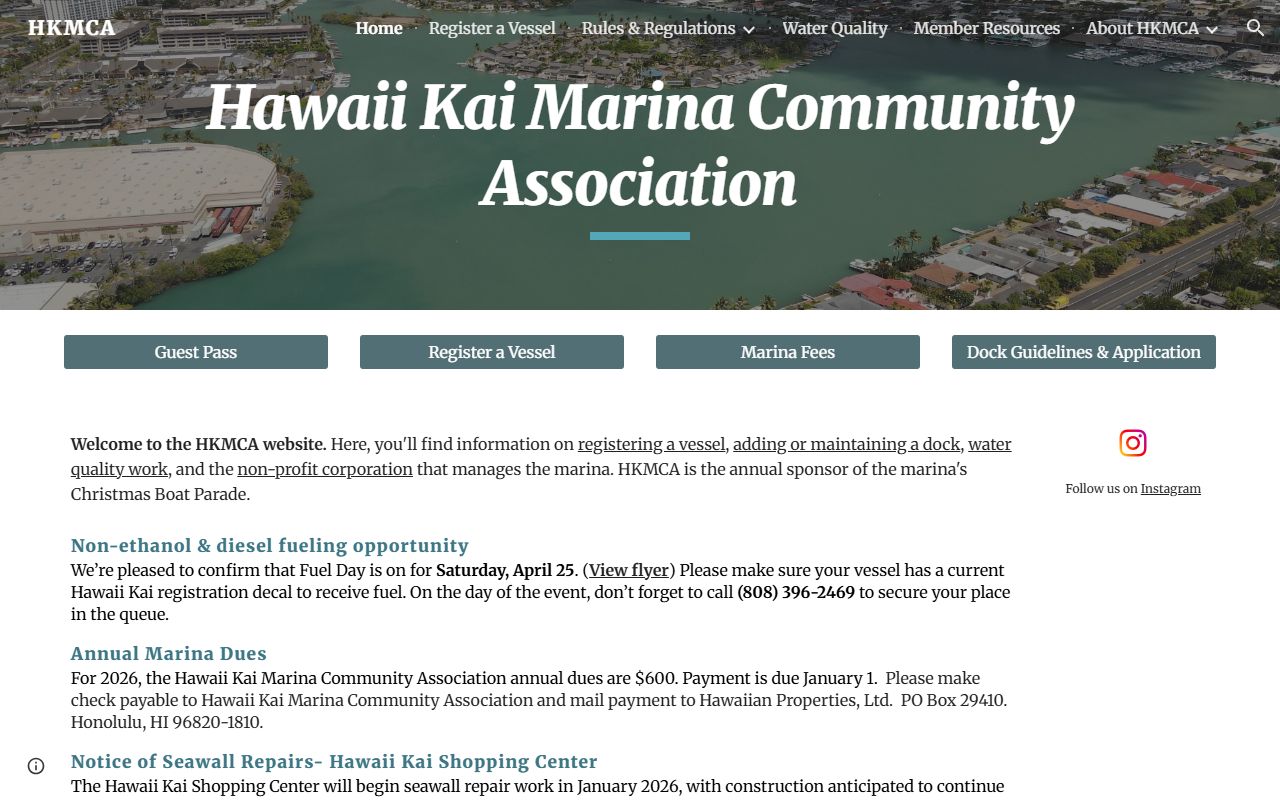
The marina website is a useful starting point for understanding what rights are tied to a given parcel and how the association structures shared ownership of the water access system.
Beyond the marina itself, Hawaii Kai is a planned community with private roads and a mix of single-family homes and condominiums near Koko Marina. Property values here vary quite a bit depending on whether a lot has ocean frontage, canal access, or neither. RPAD appraisers are expected to account for those differences, but it's worth checking your record to make sure the right factors were applied to your parcel.
Residential A and High-Value Properties in East Honolulu
East Honolulu has a high concentration of properties that fall into Honolulu County's Residential A tax classification. This class was created specifically for high-value residential parcels that do not qualify for the home exemption. If your property's assessed value exceeds $1 million and you don't have an exemption on file, RPAD will likely classify it as Residential A rather than standard Residential.
Residential A is split into two tiers. The first tier covers value from $1 million up to $1.5 million, taxed at $4.50 per $1,000 of assessed value. The second tier applies to value above $1.5 million, taxed at $9.00 per $1,000. Both tiers apply to the same parcel if the total value crosses the upper threshold. You can read more about how RPAD applies this class at realproperty.honolulu.gov/help-resources/residential-a/.
Here's a concrete example. Say your East Honolulu home is assessed at $2 million and you don't have a home exemption on file. The first $1 million below the Residential A threshold is not the issue here. The first $500,000 above $1 million is taxed at $4.50 per $1,000, which comes to $2,250. The remaining $500,000 above $1.5 million is taxed at $9.00 per $1,000, which adds another $4,500. That's $6,750 in tax just on the Residential A portion, and the total bill can reach roughly $15,000 when you account for the full assessed value under the tiered structure.
Now add a home exemption. Owners under age 65 get a $120,000 exemption. With that applied, the taxable value drops, and the property may shift partly or fully out of the higher Residential A tier. On a $2 million home with a valid exemption, the tax bill can fall to around $6,650 annually. That's a significant difference and a strong reason to make sure your exemption is filed and active.
Standard Residential with a home exemption is taxed at $3.50 per $1,000. The gap between standard Residential and Residential A tier 2 is substantial, which is why classification matters so much for East Honolulu homeowners. Check your current class in the RPAD portal and verify it matches what you expect.
Appealing Your East Honolulu Property Tax Assessment
RPAD assigns specialized residential appraisers to the East Honolulu district, which covers Hawaii Kai, Aina Haina, Niu Valley, Waialae-Kahala, and Kuliouou. These appraisers pull comparable sales from within these neighborhoods to support their value estimates. The area's terrain creates real valuation challenges. Ocean views, ridge lots, valley floors, and waterfront access all affect value in ways that mass appraisal methods sometimes miss.
If you think your assessment is too high, you have a short window to appeal. The appeal period runs from December 15 through January 15. That's just 30 days. The filing fee is $50 per parcel, and you submit your appeal to the Board of Review. RPAD provides details on the process at realproperty.honolulu.gov/appeals/appeal-information/.
For East Honolulu appeals, the strongest arguments are property-specific. Don't assume that a sale from a different valley or a different ridge will help your case. RPAD appraisers know this area and may not accept a comp from Aina Haina if your property is in Hawaii Kai. Focus on sales that are truly similar: same micro-location, same view corridor, similar lot configuration and road access. A sale just two streets over might be more relevant than one a mile away with a better ocean view.
Other factors worth documenting: deferred maintenance, lot access limitations, view obstructions added after the assessment date, easements that limit use, or any damage not yet repaired. The October 1 assessment date is fixed. What the property looked like on that date is what matters, not what it looks like when you file the appeal.
The relevant statute framework for property assessments in Hawaii is HRS Chapter 246, which governs real property taxation statewide. County ordinances set the actual rates and some procedural details, but the state law defines how assessments must be conducted and what rights owners have in the appeal process.
The RPAD FAQ page shown below covers key dates and common questions about the assessment cycle. It's a practical resource if you want to confirm deadlines before you act.
Honolulu County RPAD FAQ and Important Dates
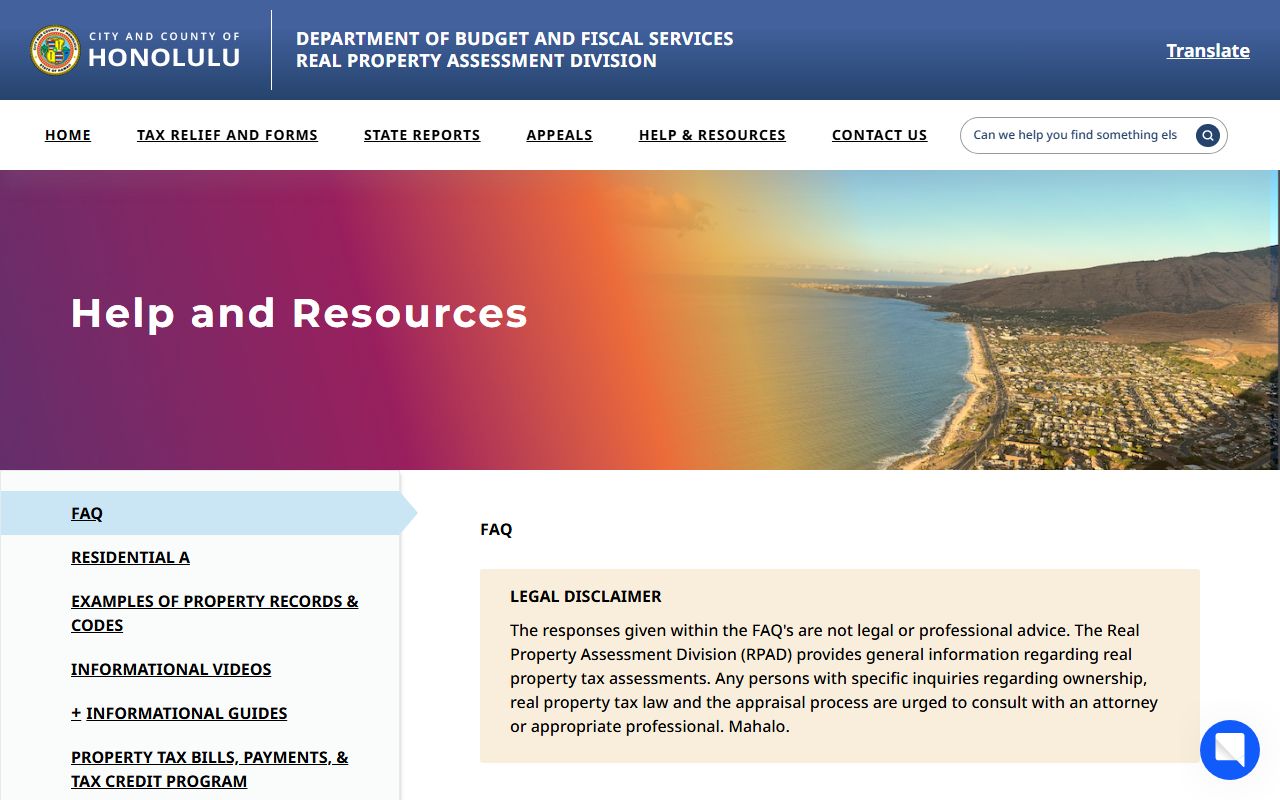
The FAQ page is updated each assessment cycle and shows current deadlines for exemption filings, appeal windows, and payment due dates.
Exemptions and Key Dates for East Honolulu Owners
The home exemption is the most important tax relief tool for East Honolulu residents. If this is your primary home, you should have an exemption on file. It reduces your taxable assessed value and, for high-value properties, can shift you out of the Residential A classification entirely or lower you into the first tier from the second. The deadline to file is September 30. Miss it, and you wait another year.
Owners under age 65 get a $120,000 home exemption under current rules. That amount rises to $140,000 starting July 1, 2027. Owners age 65 and older get $160,000 now, rising to $180,000 in 2027. If you've recently turned 65, it's worth re-checking your exemption status. You may qualify for the higher amount going forward. Forms are available at realproperty.honolulu.gov/tax-relief-and-forms/forms/.
Beyond the basic home exemption, Honolulu County offers additional relief for certain low-income seniors, disabled veterans, and totally disabled owners. These programs have their own eligibility rules and deadlines. If you think you might qualify, check the RPAD forms page or call the office directly.
The Honolulu County property tax year runs July 1 through June 30. Taxes are billed in two halves. The first half is due August 20. The second half is due February 20. Late payments carry penalties, so mark those dates early. Payment can be made online through the county's payment portal, by mail, or in person.
Here is a summary of the key dates in the annual cycle:
- October 1: Official assessment date for all parcels
- September 30: Deadline to file or update a home exemption
- December 15: Assessment notices mailed to all property owners
- December 15 to January 15: Appeal filing window ($50 fee per parcel)
- August 20: First-half tax payment due
- February 20: Second-half tax payment due
Hawaii's statutes governing property transfers and recorded interests are in HRS Chapter 502, which covers land court registration and recorded documents. If you're researching the ownership history of an East Honolulu parcel or need to confirm what's recorded against a property, that chapter is worth reviewing alongside the RPAD assessment record.
One more thing worth noting: Kahala stands apart even within East Honolulu. Beachfront estates along Kahala Avenue and on Black Point carry some of the highest land values in the state, with some parcels valued at $20 million or more. For those properties, the land value often exceeds the building value by a wide margin. If you own or are researching a parcel in Kahala, expect the land-to-improvement ratio in RPAD's records to look very different from what you'd see in other residential neighborhoods.
Honolulu County Property Tax Records
East Honolulu is part of Honolulu County, and all property tax records here are administered at the county level through RPAD. For broader information on how Honolulu County handles assessments, rates, and appeals across the island, visit the county page.
Nearby Cities
These cities are near East Honolulu. Each one is also served by Honolulu County RPAD for property tax purposes.