
Find Kapolei Property Tax Records
Kapolei property tax records are managed by the Honolulu County Real Property Assessment Division, which operates a full-service satellite office right in Kapolei for the convenience of Leeward Oahu property owners. Known as Oahu's "Second City," Kapolei is a planned urban center with a wide range of property types including single-family homes, condominiums, commercial centers, and industrial parks. Median home values for residential properties run around $700,000, though values vary from affordable housing developments to executive homes in gated communities. You can search assessments, check exemption status, and review payment records online through the county's free public portals without a trip to any office.
Kapolei Overview
Where to Find Kapolei Property Tax Records
Kapolei is one of the few communities on Oahu where you can handle property tax matters without driving to downtown Honolulu. The Honolulu County Real Property Assessment Division operates a satellite office in Kapolei that handles all RPAD functions for properties from Ewa to Waianae. This office serves the entire Leeward side of the island. You can meet with staff, access public computers for record research, print forms, and request appointments with appraisers for complex matters, all at the local office.
The Kapolei satellite office is at 1000 Uluohia Street, Suite 206, Kapolei, HI 96707. Phone is (808) 768-3799. Hours are Monday through Friday, 7:45 AM to 4:30 PM. The main RPAD office downtown at 842 Bethel Street, Basement, Honolulu, HI 96813 handles the same functions if you ever need to go to the central location, but for most Kapolei owners the satellite is far more practical.
| Office | Honolulu County RPAD - Kapolei Satellite |
|---|---|
| Address | 1000 Uluohia Street, Suite 206 Kapolei, HI 96707 |
| Main Office | 842 Bethel Street, Basement Honolulu, HI 96813 |
| Phone | (808) 768-3799 |
| Hours | Monday through Friday, 7:45 AM to 4:30 PM |
| Main Portal | realproperty.honolulu.gov |
| Property Search | qpublic.honolulugov.org |
Beyond in-person service, the RPAD portal at realproperty.honolulu.gov handles most needs online. Exemption forms, appeal instructions, payment information, and the FAQ with key dates are all there. The public search tool at qpublic.honolulugov.org lets anyone look up any Kapolei parcel at no cost.
Searching Kapolei Property Records Online
The free parcel search at qpublic.honolulugov.org works without an account. Search by owner name, street address, or tax map key number. The TMK format in Honolulu County follows division, zone, section, plat, and parcel. Using the TMK directly pulls the exact parcel without sorting through name variations or address formatting issues.
A typical Kapolei parcel record shows assessed land value, improvement value, total assessed value, tax classification, exemptions applied, and the calculated annual tax amount. You can pull prior-year assessment history to see how values have changed. That history is useful when building an appeal or evaluating whether a recent jump in value is consistent with what similar properties have experienced across the Leeward market.
For deed and ownership history, the State of Hawaii Bureau of Conveyances holds official land records. Their search is at boc.ehawaii.gov. Recorded transfers, mortgages, liens, and easements are searchable by party name or document type. Under HRS Chapter 502, conveyances must be recorded to provide legal notice of ownership. Pulling both the RPAD record and Bureau of Conveyances history gives a complete picture of any Kapolei parcel. Fee schedules for Bureau of Conveyances services are at cca.hawaii.gov/boc/fees/.
Tax payment status is also viewable through the RPAD portal. If you received a delinquency notice or want to confirm that a payment posted correctly before a real estate closing, this is the place to check. The system shows current-year bills, payment dates, and any outstanding balance.
HCDA District Properties: What Kapolei Owners Need to Know
Some Kapolei properties fall within the Hawaii Community Development Authority's jurisdiction. HCDA, located at 461 Cooke Street, Honolulu, oversees development and land use in designated community development districts, and portions of Kapolei fall under that umbrella. HCDA maintains its own records on special development agreements, ground leases, and other arrangements that can affect how a property is used and transferred.
If your Kapolei property is in an HCDA district, the assessed value set by RPAD is still the controlling figure for property tax purposes. But the existence of a ground lease, development agreement, or resale restriction tied to HCDA can affect the market value of the property, and by extension what a fair assessment should look like. If your parcel is subject to HCDA restrictions that limit its market value below what RPAD has assessed, that is worth documenting and raising during the appeal window.
Affordable housing units in Kapolei may carry deed restrictions limiting resale prices. These restrictions directly affect the market value a buyer would pay, and assessments should reflect that. If your affordable housing unit is being assessed at the same per-square-foot rate as market-rate homes in the same development, and the resale restriction limits what you can actually receive, review the comparables used by RPAD carefully.
Commercial and industrial properties in Kapolei are assessed under different tax classification rules than residential parcels. If your property has mixed uses or if commercial use has recently changed, verify that RPAD has classified it correctly. The wrong classification can mean the wrong tax rate. Under Hawaii Revised Statutes Chapter 246, counties set tax rates by class, and the classification assigned to your parcel determines which rate applies.
The screenshot below shows the Honolulu County RPAD appeal procedures page, which outlines the formal process for Kapolei property owners who want to challenge their assessments.
Honolulu County RPAD Appeal Information
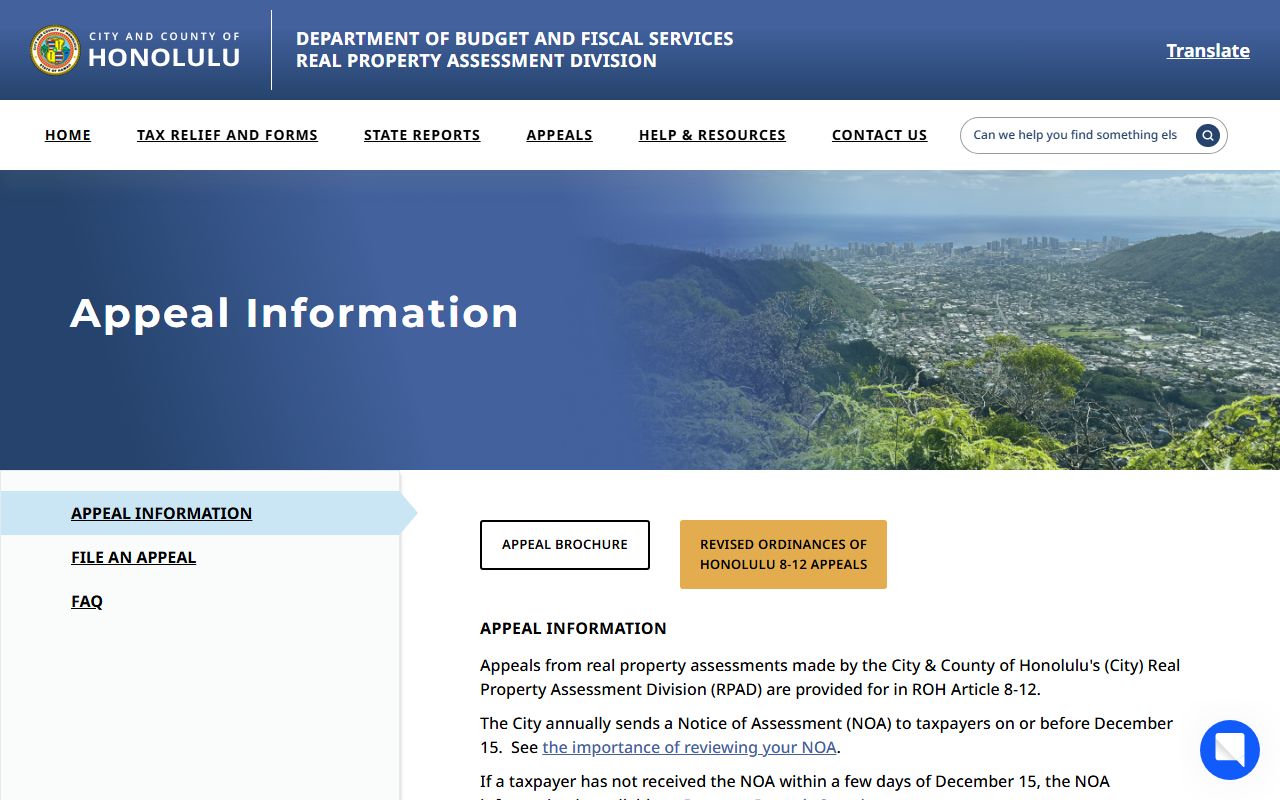
Kapolei owners who believe their assessed value is too high can use the appeal procedures outlined on this page to file a formal challenge with the Real Property Assessment Appeals Board.
Assessment Factors Specific to Kapolei
Kapolei sits within the Leeward Oahu assessment district. RPAD appraisers assigned to this district handle all residential, commercial, and industrial parcels in the area. The wide variety of property types in Kapolei, from affordable townhomes to executive gated communities to big-box retail and industrial warehouses, means appraisers must draw on different comparable pools depending on what they are assessing.
Newer construction in Kapolei is generally well-captured in assessments because the building stock is relatively recent and sales data is available. The challenge is in matching the right comparables to diverse housing types. An affordable housing unit and a market-rate single-family home in adjacent Kapolei neighborhoods are not good comparables for each other, even if the addresses look similar on a map. If your assessment notice seems to have used inappropriate comparables, request the RPAD workfile for your parcel before filing an appeal. The workfile shows what comparables were used and what adjustments were applied.
Large commercial parcels and industrial properties in Kapolei are assessed using income capitalization approaches in addition to comparable sales. If your commercial property assessment seems high, look at whether RPAD used income data that reflects actual market rents in the Kapolei area versus assumptions from other Oahu markets where rents differ. The Leeward commercial market has its own dynamics.
Exemptions and Key Dates for Kapolei Owners
The Honolulu County home exemption reduces taxable assessed value on a primary residence. Owners under 65 get $120,000 off. Owners 65 and older receive $160,000. The form is at realproperty.honolulu.gov. File by September 30 for the exemption to apply to the following tax year. The exemption stays in place as long as you own and occupy the home as your primary residence, with no annual renewal needed.
New Kapolei buyers need to file their own exemption applications. A prior owner's exemption does not transfer. The deadline is September 30. Missing it costs you the full non-exempt tax rate for an entire year. On a $700,000 property that adds up. Make filing the exemption one of the first things you do after closing on a Kapolei home.
Key dates for the tax year: October 1 is the assessment date. Notices go out around December 15. The appeal window runs from December 15 through January 15. The first payment of the annual tax bill is due August 20. The second half is due February 20. Interest and penalties accrue on late payments under HRS Chapter 246.
Other relief programs are available for qualifying homeowners. Disabled veterans, low-income elderly owners, and owners with agricultural land dedications may be eligible for additional reductions beyond the standard exemption. Check the RPAD FAQ at realproperty.honolulu.gov for current eligibility requirements and deadlines for each program.
Below is the Hawaii Bureau of Conveyances fee schedule, which covers recording costs for deeds and other property documents relevant to Kapolei real estate transactions.
Hawaii Bureau of Conveyances Fee Schedule

Kapolei property owners and buyers recording deeds, mortgages, or other conveyance documents with the Bureau of Conveyances should review this fee schedule before submitting documents.
Appealing Your Kapolei Assessment
If your assessment seems wrong, the process to challenge it is set. File your appeal with the Real Property Assessment Appeals Board during the December 15 through January 15 window. Forms and full instructions are at realproperty.honolulu.gov. The appeal board reviews your evidence and the county's support for the assessed value. Both sides present their case and the board decides.
Strong appeals come with evidence. For residential Kapolei properties, gather sales of comparable homes from the six months surrounding October 1. Look for homes with similar size, age, condition, and location within Kapolei. If your home has features that set it apart negatively, such as a location near a busy road, an unusual lot shape, or deferred maintenance, document those with photos and descriptions. The goal is to show the board what a willing buyer would pay for your specific property on the assessment date.
For commercial or mixed-use Kapolei properties, consider getting a formal appraisal. A licensed appraiser who knows the Leeward market can produce a credible opinion of value that carries weight with the board. The cost of an appraisal is often small compared to the tax savings if the appeal succeeds on a higher-value commercial parcel. You can also request the RPAD workfile before filing to see exactly what the assessor used, which helps you decide whether an appeal is worth pursuing and what to focus on.
The Kapolei satellite office can schedule appointments with RPAD appraisers for complex assessment matters. This is worth using before or during the appeal process. A direct conversation about how your property was valued may clarify issues or even result in an informal correction without a formal hearing.
Honolulu County Property Tax Records
Kapolei is in Honolulu County, and all property tax administration runs through the county's Real Property Assessment Division. The county page has details on tax rates by classification, assessment methodology for different property types, the full appeals process, and every county-wide program that applies to Kapolei parcels.
Nearby Cities
These Leeward Oahu communities are near Kapolei. All are served by Honolulu County RPAD for property tax administration.