
Makakilo Property Tax Records
Makakilo property tax records are managed by the Honolulu County Real Property Assessment Division, which handles all assessments for this hillside residential community on the slopes of the Waianae Mountains in Leeward Oahu. Whether you need to look up your assessed value, check exemption status, find out what you owe, or understand how your bill is calculated, the county's online portal gives you direct access to records for every parcel in Makakilo. Elevation, view corridors, and the mix of older and newer subdivisions all factor into how RPAD values these properties.
Makakilo Overview
Honolulu County RPAD and Makakilo Records
All property tax records for Makakilo fall under Honolulu County. The Real Property Assessment Division maintains the parcel data, assessment values, and tax bill history for every lot in the community. You can search online or visit the nearest RPAD office in Kapolei, which is just a short drive from Makakilo.
The online portal at realproperty.honolulu.gov gives you access to current and past assessments, land and building values, exemption records, and payment status. The public search tool at qpublic.honolulugov.org lets you look up any parcel by address or tax map key number. Both tools are free to use and don't require an account.
| Office | RPAD Kapolei District Office |
|---|---|
| Address | 1000 Uluohia Street, Suite 206 Kapolei, HI 96707 |
| Phone | (808) 768-3799 |
| Hours | Monday through Friday, 7:45 AM to 4:30 PM |
| Online Portal | realproperty.honolulu.gov |
| Parcel Search | qpublic.honolulugov.org |
The Kapolei office is closer than the main Honolulu office for Makakilo residents. Staff there can help you review your assessment notice, submit exemption applications, and answer questions about your parcel's classification. Walk-ins are welcome during regular hours.
How RPAD Assesses Makakilo Properties
Makakilo sits at varying elevations on the slopes of the Waianae Mountains. That topography creates real value differences from one parcel to the next. Properties higher up often have clear views of Pearl Harbor, downtown Honolulu, and the ocean at night. Those view corridors matter. RPAD uses comparable sales from both Upper Makakilo and Lower Makakilo when setting values, so assessments should reflect where your lot sits on the hillside.
Newer subdivisions in Makakilo have more recent construction than the older Makakilo Heights section. RPAD accounts for construction standards when it values the improvement portion of a parcel. A newer home in good condition will typically be assessed at a higher improvement value than an older one of similar size, assuming all else is equal. If you've done significant renovations or additions, that can also affect your assessed value going forward.
Many properties in Makakilo are part of homeowner associations or residential associations that set covenants on land use. RPAD considers these restrictions when evaluating what properties can and can't do. A parcel with meaningful use restrictions may not carry the same value as one without them. Review your assessment notice carefully to see how your lot is broken down between land value and improvement value.
The assessment date for Honolulu County is October 1 each year. RPAD mails notice of assessment in the fall. If you believe your assessed value is too high or your classification is wrong, you have a window to appeal. The appeal period runs from December 15 through January 15. Missing that window means waiting until the next cycle.
Makakilo Community Resources
Understanding how your neighborhood is organized can help when reviewing your assessment. The Makakilo community website documents the residential associations active in different sections of the community. This includes information on covenants, common area management, and property use rules that RPAD may factor into valuations. You can browse community details at makakilo.com.

HOA covenants and deed restrictions are part of the public record. You can look them up through the Bureau of Conveyances, which records all instruments affecting title in Hawaii. The bureau's records are searchable under HRS Chapter 502, which governs the recording of deeds, liens, and encumbrances. Knowing what restrictions apply to your parcel is useful background when comparing your assessment to nearby sales.
Home Exemption and Tax Relief
Honolulu County offers a home exemption to owner-occupants who use their property as their primary residence. The exemption reduces the assessed value used to calculate your tax bill. For homeowners under age 65, the exemption is $120,000. Owners who are 65 or older get a larger exemption of $160,000. You must file your application by September 30 to get the exemption for the following tax year.
You only need to file once. After RPAD approves it, the exemption stays in place as long as you keep the property as your primary residence. If you sell, move out, or rent the home, you need to notify RPAD and the exemption comes off. Filing a false claim can result in back taxes and penalties.
The exemption form is available directly from RPAD at realproperty.honolulu.gov. You can download, fill it out, and mail it in or drop it off at the Kapolei office. RPAD also offers other exemptions for disability, totally disabled veterans, and certain non-profit uses. Call (808) 768-3799 to ask which ones might apply to your situation.
Honolulu RPAD Online Portal
The Honolulu County Real Property Assessment Division portal is the main tool for looking up property tax records online. You can access assessment history, current tax bills, exemption status, and payment records from the portal without visiting an office. The screenshot below shows what the portal looks like when you access it at realproperty.honolulu.gov.
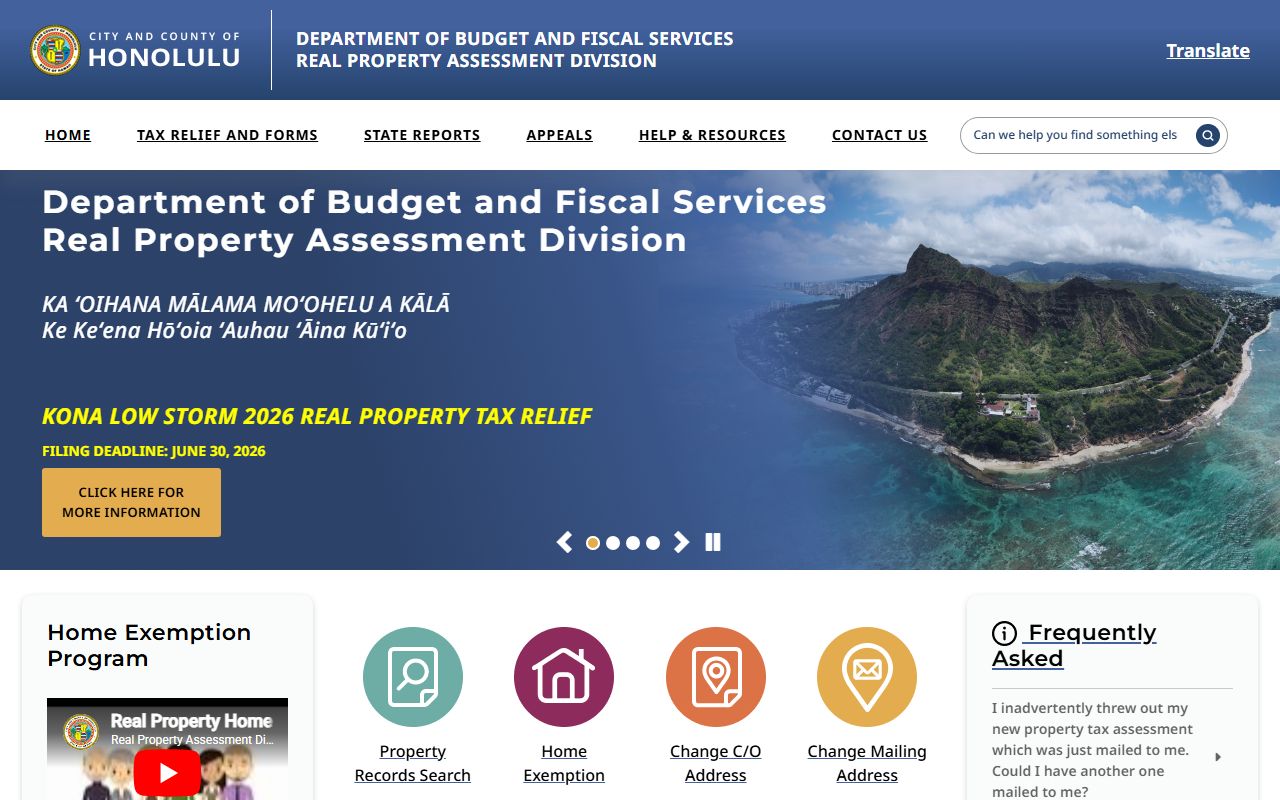
From the portal, you can also find links to the qPublic parcel search, appeal forms, and the county's tax rate schedule. The portal is updated on a regular basis. If you notice a discrepancy between what you see online and what your notice says, call RPAD directly before filing an appeal.
Key Dates and Payment Schedule
Honolulu County sends out two property tax bills each year. The first installment is due August 20. The second installment is due February 20. If you pay your full annual tax by August 20, you don't need to make a second payment. Missing a due date triggers interest charges, so it's worth marking these on your calendar.
The assessment date is October 1 each year. That's when RPAD sets the value that will be used for the next tax year. Assessment notices go out in the fall. The appeal window opens December 15 and closes January 15. You must file your appeal before January 15 or the assessed value becomes final for that year.
Exemption applications are due September 30. If you move into a new home, don't wait. File as soon as you can confirm it's your primary residence. RPAD reviews all new exemption claims and may ask for supporting documents. Keep a copy of your application and any confirmation you get back.
For appeal information and forms, go to realproperty.honolulu.gov/appeals. You can also find the governing law for property taxes in Hawaii under HRS Chapter 246, which sets out assessment procedures, rates, and taxpayer rights statewide.
Honolulu County Property Tax Records
Makakilo is in Honolulu County, and all property tax administration for this community runs through the county's Real Property Assessment Division. The county page has more detail on tax rates by class, the full appeal process, and resources for other parts of Honolulu County.
Nearby Cities
These nearby communities are also in Honolulu County and follow the same RPAD processes for property tax records.