
Find Waipahu Property Tax Records
Waipahu property tax records are maintained by the Honolulu County Real Property Assessment Division, which assesses every parcel in this Leeward Oahu community and sends out annual tax bills. Waipahu developed as a sugar plantation town, and that history shapes the housing stock today. Many homes date to the 1920s through 1940s and were built for plantation workers, giving Waipahu a more affordable price point than many other parts of Oahu. Median home values run around $650,000. You can search property records, check assessed values, view payment history, and access exemption information for free through the county's online portals.
Waipahu Overview
Where to Find Waipahu Property Tax Records
There is no separate Waipahu tax office. All real property assessment and billing for Waipahu goes through Honolulu County's Real Property Assessment Division. RPAD is responsible for every step: setting assessed values, assigning tax classifications, processing exemptions, and collecting taxes on behalf of the county. That single-agency structure means you always know where to go.
The main RPAD office is located downtown at 842 Bethel Street, Basement, Honolulu, HI 96813, phone (808) 768-3799. Hours are Monday through Friday, 7:45 AM to 4:30 PM. That is a drive from Waipahu, but the county also operates a satellite office on the Leeward side at 1000 Uluohia Street, Suite 206, Kapolei, HI 96707. For most Waipahu residents, the Kapolei location is the more convenient choice for any in-person needs.
| Office | Honolulu County Real Property Assessment Division (RPAD) |
|---|---|
| Main Address | 842 Bethel Street, Basement Honolulu, HI 96813 |
| Leeward Satellite | 1000 Uluohia Street, Suite 206 Kapolei, HI 96707 |
| Phone | (808) 768-3799 |
| Hours | Monday through Friday, 7:45 AM to 4:30 PM |
| Main Portal | realproperty.honolulu.gov |
Online access is available around the clock through realproperty.honolulu.gov. That portal connects to the property search tool, forms, appeal instructions, and the FAQ page with all the important annual dates. For most questions about a specific Waipahu parcel, the online tools give you what you need without a trip to any office.
Searching Waipahu Property Records Online
The county's public search tool is at qpublic.honolulugov.org. It is free to use and requires no login. You can search any Waipahu parcel by owner name, street address, or tax map key number. The tax map key is a specific identifier assigned to each parcel by the county. If you have it, that is the fastest way to pull a record directly.
A typical Waipahu parcel record shows the assessed land value, improvement value, total assessed value, the tax classification applied, any exemptions currently on file, and the resulting annual tax amount. You can also see assessment history for past years. That history is useful for spotting large jumps in value or confirming whether an exemption was properly applied in a given year. The data is current and reflects the most recent completed assessment cycle.
Deed records, conveyance documents, and title history are kept by the State of Hawaii Bureau of Conveyances. Their online search is available at boc.ehawaii.gov. You can look up recorded documents by owner name or document type. For Waipahu properties, this is especially relevant because many parcels have title histories going back to plantation-era subdivisions. Easements, restrictions, and deed conditions from decades ago can still affect value and use today.
Tax payment status is also viewable through the RPAD portal. Buyers and owners can confirm whether taxes are current, check prior payment dates, and verify there are no outstanding balances. This matters before a sale closes and after receiving any delinquency correspondence.
Assessment in Waipahu: Older Housing and Plantation History
Waipahu's housing stock is older than most Oahu communities. A significant share of homes were built during the plantation era, between the 1920s and 1940s, as worker housing for the Oahu Sugar Company. These homes are often smaller, built on modest lots, and may not have been substantially updated. RPAD uses comparable sales within the Leeward Oahu assessment district when setting values, and homes in original condition are benchmarked against other unimproved properties rather than against renovated or newer construction nearby.
That distinction matters for owners. If your Waipahu home is original condition and the assessment seems to reflect renovation work it does not actually have, that is a legitimate basis for review. RPAD should be comparing your property to similar unimproved homes. Conversely, if you have made additions or upgrades, a higher assessment reflects that accurately. Knowing how RPAD categorizes your property is the first step in understanding whether the value is reasonable.
Some Waipahu parcels originated as agricultural lands used by the sugar plantation. Former sugarcane fields that were subsequently subdivided into residential lots may still carry agricultural dedication restrictions or be eligible for reduced assessment under Hawaii's agricultural dedication programs. Owners of any Waipahu property with remaining agricultural use should verify whether a dedication benefit has been properly applied. Failing to claim it can mean paying higher taxes than required under HRS Chapter 246.
Multi-family properties and rental homes in Waipahu face a different classification. Properties rented out to non-owner occupants are often classified as Commercialized Residential rather than Residential. That classification carries a higher tax rate. If a Waipahu property generates rental income, RPAD may use an income approach to estimate value rather than relying solely on comparable sales. Owners of multi-unit or rental properties should review their classification each year to make sure it is correct and that any income-based valuation uses accurate data.
RPAD sets assessments as of October 1 each year at 100% of fair market value. If you believe your Waipahu property's assessed value does not reflect what it would actually sell for on that date, you can file an appeal. The appeal process starts with RPAD and, if needed, can proceed to the county Real Property Assessment Appeals Board. Information is at realproperty.honolulu.gov. Use comparables from the same Leeward Oahu district when building your case.
The Waipahu Public Library, shown below, provides free access to property records, historical assessment materials, and local history collections that support property research in Waipahu.
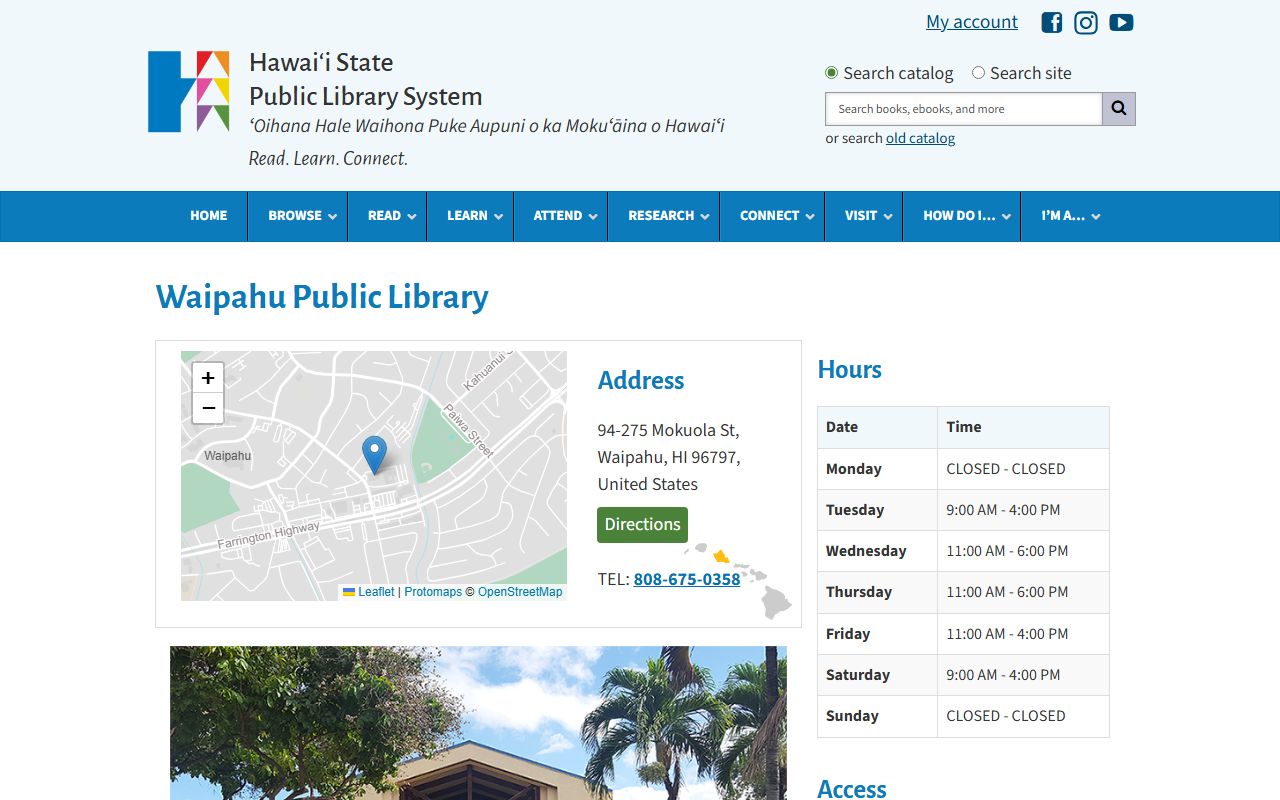
The library's local history collection includes maps of original plantation land divisions and historical records that help owners trace chain of title and understand early easements affecting their properties.
Exemptions and Key Dates for Waipahu Property Owners
Honolulu County's home exemption reduces the taxable assessed value of your primary residence. If you are under 65, the exemption amount is $120,000. Owners 65 or older qualify for a $160,000 exemption. To claim it, file Form BFS-RPA-E-8-10.3 by September 30. You can get the form and instructions at realproperty.honolulu.gov. Once you file and are approved, the exemption stays active each year as long as you keep the property as your primary home.
New Waipahu buyers sometimes miss the September 30 deadline. If you close on a home in October and the prior owner's exemption was in place, that exemption ends with their ownership. You must file your own before the next September 30 to get the benefit for the following tax year. That one-year gap can add real dollars to your tax bill. Filing promptly after purchase is the right move.
Other programs exist for qualifying owners. Low-income homeowners, certain veterans, and disabled residents may be eligible for additional relief. Check the RPAD website for full eligibility details. Agricultural dedication programs, relevant for any Waipahu parcel still meeting agricultural use requirements, provide reduced assessments in exchange for keeping land in qualifying agricultural use.
The key dates for the Waipahu tax year are straightforward. October 1 is when RPAD sets the assessment value. Notices go out around December 15. The window to file an appeal runs from December 15 through January 15. The first half of the annual tax bill is due August 20. The second half comes due February 20 the following year. Late payments bring penalties and interest charges. Mark those dates and pay on time to avoid extra costs under HRS Chapter 246.
Library Resources and Additional Research Tools
The Waipahu Public Library is a practical starting point for deeper property research. It holds local history materials that go beyond what digital databases provide, including historical maps of original land divisions and plantation housing layouts. These materials help with chain of title research, identifying old easements, and understanding how current parcels were carved from larger plantation tracts. The library's contact and hours are at librarieshawaii.org.
The library's collection also includes oral histories and photographs that document how Waipahu developed from a plantation community into its current suburban form. That historical context can matter in property research. Old deed conditions, access easements, and use restrictions sometimes trace back to the original plantation subdivisions. Understanding where those came from helps owners and buyers know what they are dealing with.
Bureau of Conveyances records under HRS Chapter 502 are the official source for recorded deed and title documents. Their online index at boc.ehawaii.gov lets you search by owner name or document type. For Waipahu's older properties, some records may not be fully digitized. In those cases, you can request copies directly from the Bureau's Honolulu office. The combination of Bureau records and the Waipahu library's local collection gives you the most complete picture available for historic parcels.
The Hawaii Plantation Village, a private museum at hawaiiplantationvillage.org, holds archives related to plantation-era life and property use in Waipahu. While its holdings are not official government records, the museum's materials can supplement title research for properties with deep plantation roots. For anyone tracing an old easement or trying to understand a deed restriction that has unclear origins, that kind of contextual archive is worth exploring.
If a county-level appeal does not resolve your assessment dispute, the Hawaii State Tax Appeal Court handles further challenges through the state judiciary. You can find information about that process at courts.state.hi.us. Most owners do not need to go that far, but the state court route is available when the county board decision is unsatisfactory.
The Honolulu County RPAD FAQ and important dates page, shown below, is a key reference for Waipahu property owners managing exemption deadlines, appeal windows, and payment due dates.
Honolulu County RPAD FAQ and Important Dates
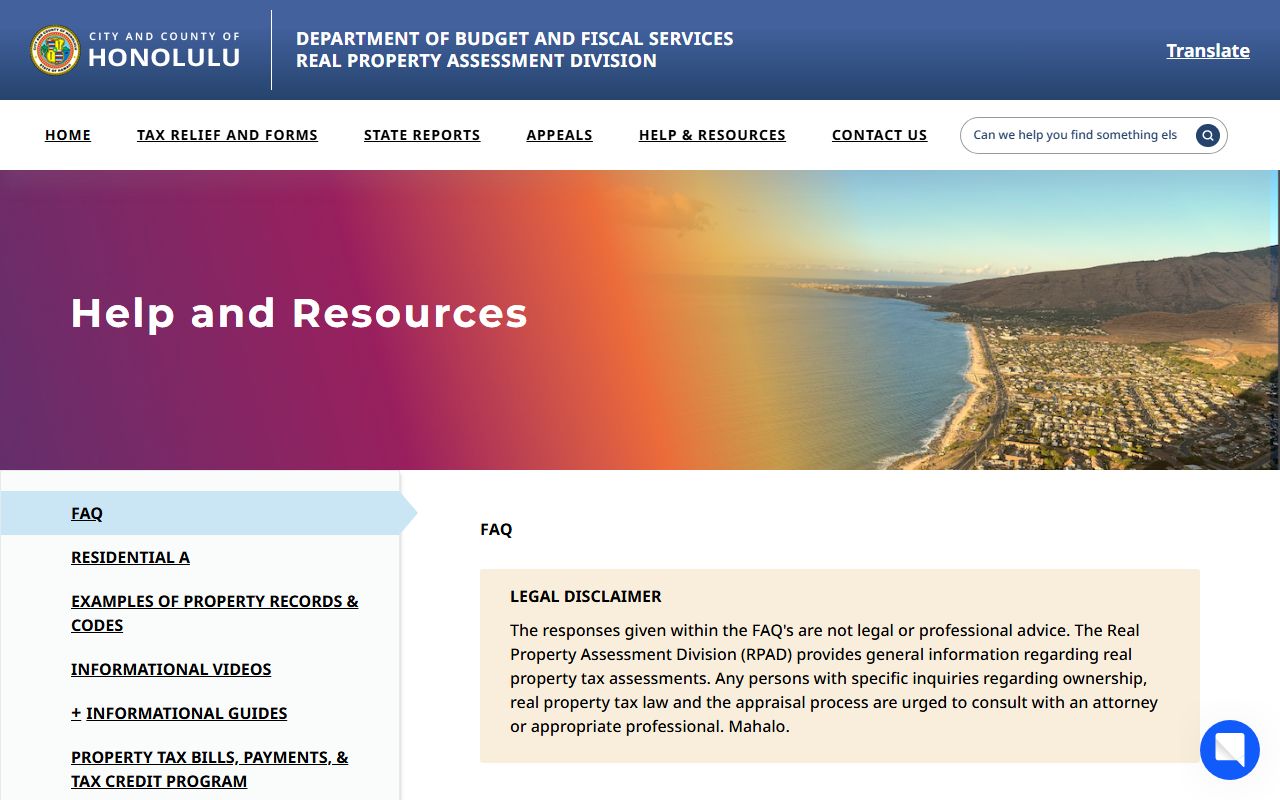
Waipahu owners should review the RPAD FAQ page each fall to confirm current deadlines for exemption filings and appeal periods, as these dates are critical for protecting your tax benefits.
Honolulu County Property Tax Records
Waipahu is part of Honolulu County. All property tax functions run through the county's Real Property Assessment Division. The county page covers assessment methods, full tax rate schedules by property class, the complete appeals process, and county-wide programs that apply to every Waipahu parcel.
Nearby Cities
These Oahu communities are close to Waipahu and fall under the same Honolulu County property tax system.