
Schofield Barracks Property Tax Records
Schofield Barracks property tax records present a unique situation: the installation itself is federal land and is fully exempt from Hawaii property taxes, so there are no county tax records for the base. However, civilian property owners in the surrounding communities of Wahiawa and Mililani do pay Honolulu County property taxes, and those records are available through the county's Real Property Assessment Division. Military presence, training noise, and aircraft activity can all affect how nearby civilian properties are assessed. This page explains the federal exemption, how it works, and what civilian owners in the area need to know about finding records, filing exemptions, and appealing assessed values.
Schofield Barracks Overview
Why Schofield Barracks Has No Property Tax
Schofield Barracks is owned by the federal government. Under federal law, the United States government does not pay state or local property taxes on land it owns. That is a long-standing principle of federal sovereignty, and it applies to all military installations across the country.
The installation covers a large portion of Central Oahu and includes housing areas, training ranges, airfields, and support facilities. All of that land is off the Honolulu County tax rolls entirely. The RPAD does not assign parcel numbers or assessed values to federal property. If you search the county parcel database and look for a street address on the base, you will not find a standard tax record. That is expected. The land is exempt by law.
Privatized military housing adds a layer of complexity. Under privatization, private developers operate and maintain the housing under long-term ground leases with the military. Even so, the underlying land is still federally owned, and the housing is considered part of the military use. That means the privatized housing units are also not subject to Hawaii property tax. Service members living in privatized housing do not receive county tax bills.
The key point for anyone searching records: if you are looking for a property inside the Schofield Barracks installation boundary, you will not find standard Honolulu County property tax records for it. The records that do exist are civilian properties in the surrounding communities.
Finding Records for Civilian Properties Near Schofield
Civilian homeowners in Wahiawa, Mililani, Mililani Mauka, and other communities around the base have standard Honolulu County property tax records. Those are fully accessible through the RPAD system.
The public parcel search is at qpublic.honolulugov.org. You can search by owner name, parcel number, or street address. The record shows assessed land value, building value, total assessed value, tax classification, any exemptions, and the annual tax amount. The main RPAD portal is at realproperty.honolulu.gov, where you can also find forms, rate schedules, and appeal information.
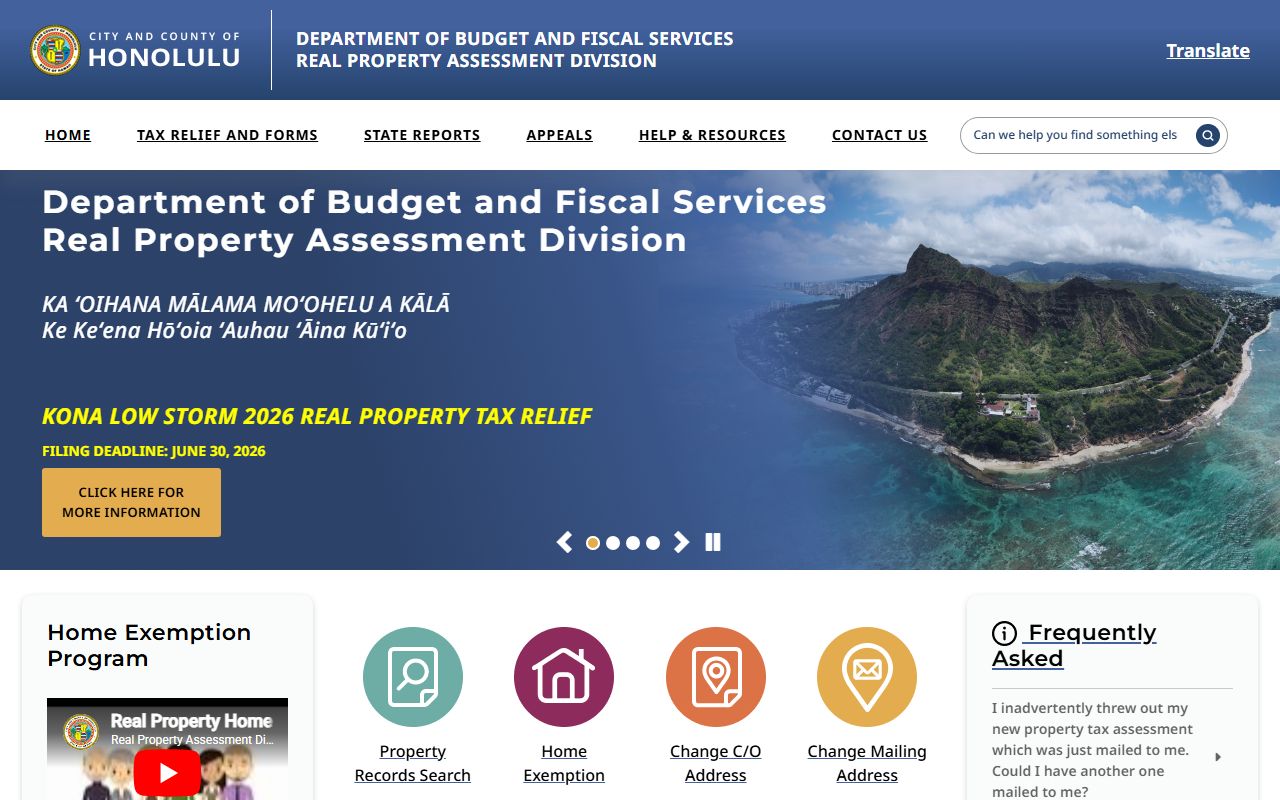
The Honolulu County Real Property Assessment Division portal, shown below, is where civilian owners near Schofield Barracks can look up parcel records and access all RPAD resources.
For questions or in-person help, the main RPAD office is at 842 Bethel Street, Basement, Honolulu, HI 96813. Phone is (808) 768-3799. Hours are Monday through Friday, 7:45 AM to 4:30 PM. Central Oahu properties including those around Schofield fall under the county's Central Oahu assessment district, which has its own team of appraisers familiar with the area.
How Military Activity Affects Civilian Assessments
Living near a major Army installation has real effects on property values. Some of those effects are positive. Others reduce values. Either way, RPAD appraisers are expected to account for them when setting assessed values for civilian properties in the area.
Training activities are one factor. Wahiawa properties closest to the base may experience noise from artillery training, helicopter and fixed-wing aircraft overflight, and periodic access disruptions. Properties within high-noise contour zones can have lower market values than otherwise comparable homes farther from the base. Aircraft noise contours and overflight easements are documented, and those can affect what buyers pay for homes in those zones.
The civilian rental market is also shaped by military presence. A large pool of military families rents in the Wahiawa and Mililani areas. That demand generally supports rental prices and can push up values for investment properties, particularly smaller single-family homes and condos. RPAD draws comparables from within the Central Oahu market, so those rental market effects show up in the data.
If you own a civilian property near the base and believe military impacts are not properly reflected in your assessed value, you have grounds to raise that in an appeal. Document the specific impacts: noise readings, proximity to training areas, frequency of overflight, or any recorded easements. Concrete data matters more than general statements about living near the base.
Older Wahiawa housing stock requires attention to condition when appealing. Some homes there date to the mid-20th century, and condition adjustments are a real factor when comparing to newer properties. RPAD appraisers are supposed to make those adjustments, but if the comparables used in your assessment did not reflect the actual condition of your property, that is a legitimate basis for appeal.
Home Exemption for Civilian Owners Near Schofield
Civilian homeowners who live in their property as a primary residence can apply for the Honolulu County home exemption. The standard exemption is $120,000 off the assessed value for owners under 65. Owners who are 65 or older get $160,000 off. The deadline to apply is September 30 each year.
The application is at realproperty.honolulu.gov/tax-relief-and-forms/exemptions/home-exemption/. File once and it renews automatically each year as long as you continue to own and occupy the property as your primary home. If you sell or move, you must notify the county.
The legal framework for property taxation in Hawaii is found in Hawaii Revised Statutes Chapter 246, which governs how assessments are made, how taxes are levied, and what rights property owners have. The Chapter 246 statutes page is shown below.
Deed and title records for civilian properties in the area are filed with the Hawaii Bureau of Conveyances under HRS Chapter 502. Those are separate from RPAD records. The Bureau handles conveyance documents; RPAD handles assessed values and tax bills.
Important Dates for Civilian Property Owners
The annual property tax cycle for civilian owners near Schofield follows the same Honolulu County schedule as all other Oahu properties.
The assessment date is October 1. Values are set as of that date and apply to the following tax year. The exemption deadline is September 30, which falls just before the assessment date. First-year owners need to file quickly after purchasing a home. The formal appeal window runs from December 15 to January 15. Tax payments are due twice a year: the first installment on August 20 and the second on February 20.
If you miss the appeal window, there is no way to contest that year's assessment through the formal process. The RPAD FAQ at realproperty.honolulu.gov/help-resources/faq/ explains what options exist and how the process works in practice.
Full appeal procedures are posted at realproperty.honolulu.gov/appeals/appeal-information/. Read those before you file. The board wants specific comparable sales, not just a general claim that the value is too high. For properties near the base, include documentation of any military impacts that affect market value if you are raising that as part of your case.
Honolulu County Property Tax Records
Civilian properties surrounding Schofield Barracks are all part of Honolulu County. The county page covers the full RPAD system, assessment process, exemption programs, and the complete appeal framework for Oahu property owners.
Nearby Cities
These communities are near Schofield Barracks and are all served by Honolulu County RPAD for property tax purposes.