
Mililani Town Property Tax Records
Mililani Town property tax records are managed by the Honolulu County Real Property Assessment Division, which handles all assessments, exemptions, and billing for this planned community in Central Oahu. Built on former pineapple lands starting in the 1960s by Castle & Cooke, Mililani Town covers a wide range of single-family homes on largely uniform lots. You can search records online, request copies by mail, or visit the RPAD office in person. This page explains how assessments work here, what exemptions are available, and where to go if you think your value is wrong.
Mililani Town Overview
Where Mililani Town Property Tax Records Are Kept
The Honolulu County Real Property Assessment Division holds all property tax records for Mililani Town. Mililani is part of Honolulu County, which covers the entire island of Oahu. That means the same office that handles Honolulu records also handles yours if you own property in Mililani Town.
The main RPAD office is at 842 Bethel Street, Basement, Honolulu, HI 96813. You can call them at (808) 768-3799. Hours are Monday through Friday, 7:45 AM to 4:30 PM. For most searches and basic record requests, the online portal is faster than going in person.
| Office | Honolulu County Real Property Assessment Division |
|---|---|
| Address | 842 Bethel Street, Basement Honolulu, HI 96813 |
| Phone | (808) 768-3799 |
| Hours | Monday through Friday, 7:45 AM to 4:30 PM |
| Online Portal | realproperty.honolulu.gov |
| Search Tool | qpublic.honolulugov.org |
The qPublic search tool at qpublic.honolulugov.org lets you look up any parcel by address, owner name, or tax map key number. Results show the assessed value, tax class, lot size, building details, and current tax amounts. It is free to use and no login is needed.
How Assessments Work in Mililani Town
RPAD assigns property values each year as of October 1. That date is the official assessment date under Hawaii Revised Statutes Chapter 246. The value on that date is what drives your tax bill for the next fiscal year.
Mililani Town falls under the Central Oahu assessment district. Because the community was built as a planned development, lots tend to be uniform in size, typically ranging from 5,000 to 7,000 square feet. Homes share similar architectural styles and setbacks. That consistency actually helps assessors, because they can model values using square footage and condition data with a fair degree of accuracy across many properties at once.
Comparable sales used for Mililani Town come from within the community itself and from nearby Mililani Mauka. RPAD generally does not pull comparables from Wahiawa or Pearl City, since those markets operate differently. Within Mililani Town, neighborhoods like Kuahelani and Olaloa may show slight value differences based on lot size, age of construction, and proximity to parks or schools.
If you have done renovations or added square footage, that work should show up in RPAD's records. If it doesn't, the assessed value might be low now, but could jump sharply once the division updates its data. It is worth checking that your property card reflects the current condition of the home. You can review your property details through the online search portal and ask for corrections if something is off.
Properties with visible deferred maintenance may be eligible for downward adjustments. Document the condition with photos and repair estimates if you plan to argue for a lower value at appeal time. Condition is one of the factors assessors are allowed to consider.
Mililani Town Association and Property Values
Mililani Town has an active homeowners association called the Mililani Town Association (MTA). The MTA manages common areas, enforces covenants, and sets community standards for property use and modifications. HOA covenants can affect what you can do with your property, which in turn can affect its market value and marketability.
The MTA does not set or influence your assessed value directly. RPAD makes that determination on its own. But if you run a home-based business or rent out part of your home, the MTA covenants may restrict that use. And if RPAD finds out a property is being used commercially, it could reclassify it to a higher tax rate. It is worth checking with both the MTA and RPAD if your property use has changed.
Non-compliance with HOA rules can result in fines or liens on the property. Those liens would show up in a title search and can affect a sale. Property records filed with the Bureau of Conveyances under HRS Chapter 502 include recorded covenants, liens, and other encumbrances. You can review those records to understand what is attached to a specific parcel.
Mililani Public Library and Property Research
The Mililani Public Library offers access to public records and local history resources that can be useful for property research. The library holds materials related to the Castle & Cooke development of Mililani Town and the transformation of pineapple lands into a residential community. That history is relevant when tracing how lots were originally platted and how development patterns may affect current values.
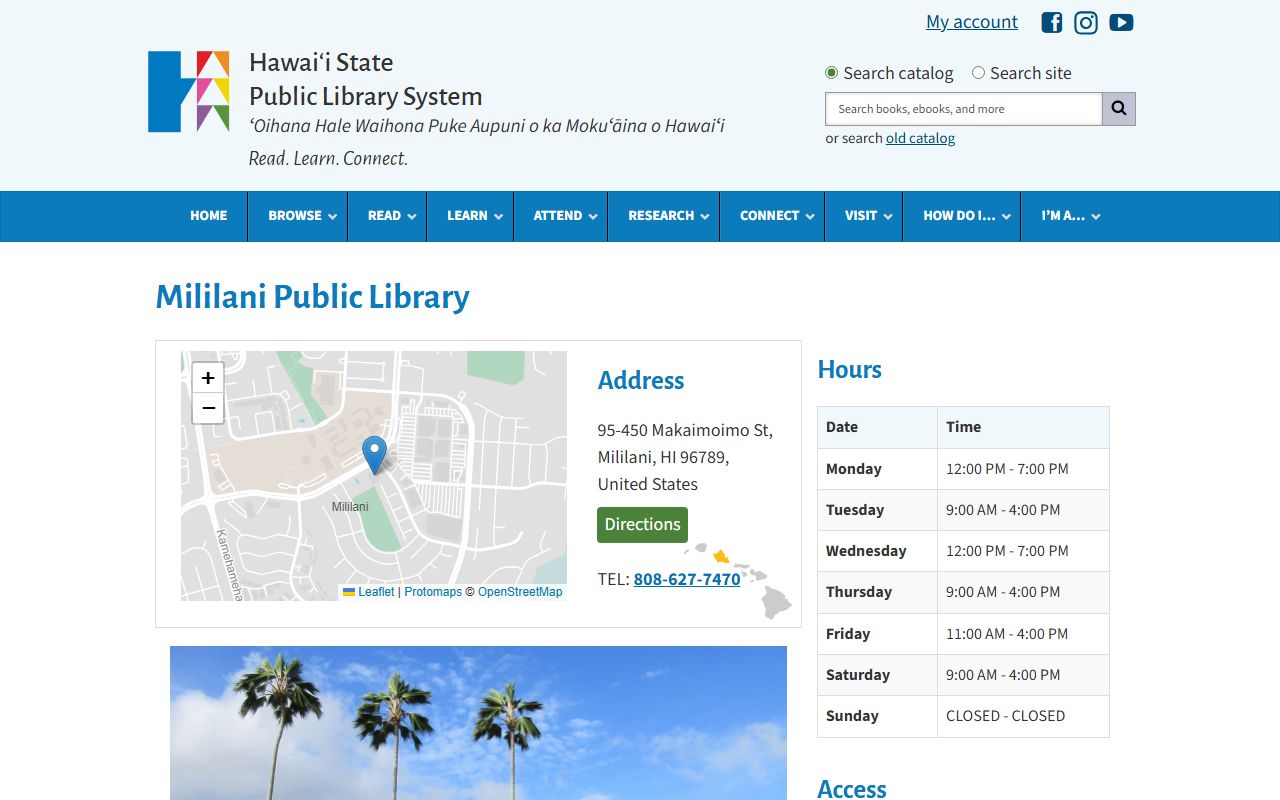
The library's online home is at librarieshawaii.org/locations/mililani-public-library/. Visit in person to access Honolulu County property records and historical plat maps that may not be available through online portals.
The image below shows the library's webpage, which lists current hours, contact information, and available services.
Home Exemption for Mililani Town Owners
If you live in your Mililani Town home as your primary residence, you can apply for the Honolulu County home exemption. The exemption reduces your assessed value by a set amount before your tax rate is applied. That means a lower tax bill each year.
The standard exemption for homeowners under age 65 is $120,000. If you are 65 or older, the exemption rises to $160,000. You must file the application by September 30 to get the exemption for the following tax year. Late filings are not accepted. You only need to apply once. The exemption stays in place as long as you continue to meet the requirements. If you sell the home or stop using it as your primary residence, you need to notify RPAD.
Find the application form and full details at realproperty.honolulu.gov/tax-relief-and-forms/exemptions/home-exemption/. All tax relief forms are also listed at realproperty.honolulu.gov/tax-relief-and-forms/forms/.
Other exemptions may also be available. Honolulu County offers relief programs for low-income owners, totally disabled veterans, and properties with special classifications. Check the RPAD website or call the office to ask what you might qualify for.
Key Dates and How to Appeal
Knowing these dates matters. Miss one and you could lose your right to challenge your assessment or claim an exemption for that year.
- October 1: Official assessment date. Values are set as of this day each year.
- September 30: Deadline to file or update your home exemption application.
- December 15 to January 15: Appeal window. You must file your appeal during this period.
- August 20 and February 20: The two annual tax payment due dates.
If you think your assessed value is too high, you can file an appeal with the Honolulu Board of Review. The process and forms are explained at realproperty.honolulu.gov/appeals/appeal-information/. You need to file within the December 15 to January 15 window. After that window closes, you cannot appeal that year's value.
When you appeal, come prepared. Sales data from within Mililani Town carries the most weight. Pull comparable sales from RPAD's own records or from public sales databases. If your argument is about condition, bring photos and contractor estimates. A clear, well-documented appeal is more likely to succeed than a vague complaint about high taxes.
The RPAD FAQ at realproperty.honolulu.gov/help-resources/faq/ answers many common questions about assessments, exemptions, and the appeal process in plain language.
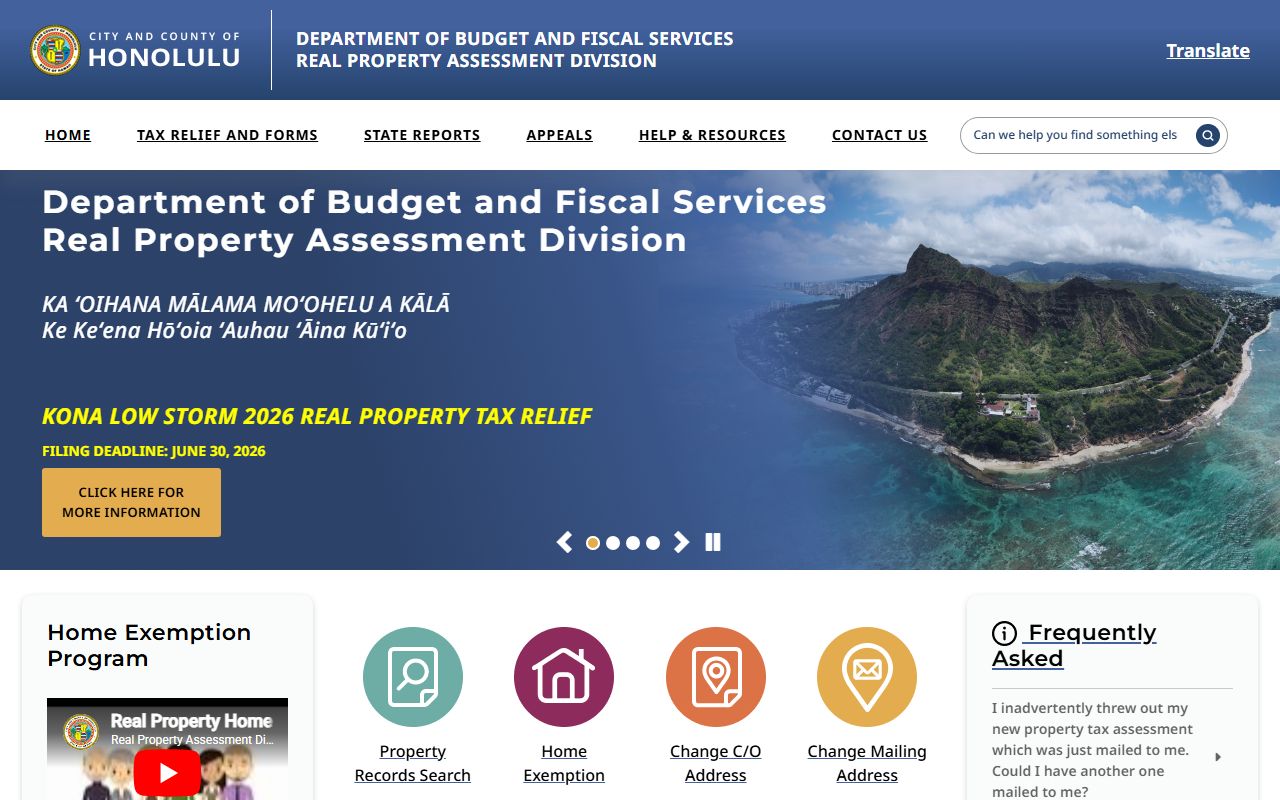
The Honolulu County Real Property Assessment Division portal is shown below. It gives you access to parcel search, tax payment history, exemption forms, and appeal information for all Oahu properties including Mililani Town.
Honolulu County Property Tax Records
Mililani Town is part of Honolulu County. All property tax assessments, bills, exemptions, and appeals go through the Honolulu County Real Property Assessment Division. For full county-level details on rates, programs, and office locations, visit the county page.
Nearby Cities
These communities are close to Mililani Town and are also served by Honolulu County's property tax system.